
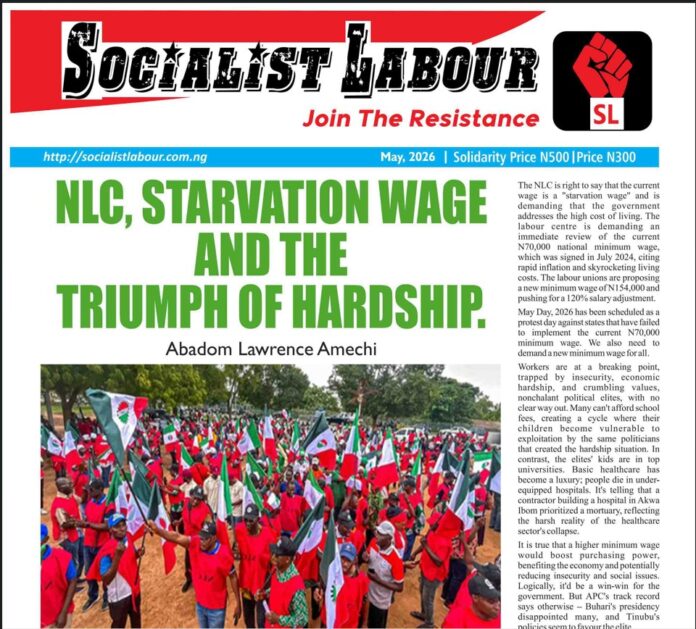

Abadom Lawrence Amechi
Workers have long suffered under the weight of poor governance, corruption, and money grabbing from those in power. The past three years under President Ahmed Bola Tinubu have been particularly tough.
The president came prepared to unleash the anti-masses programme of the Bretton Woods institutions. His policies, such as removing fuel subsidies, floating the naira, and increasing electricity tariffs, have worsened living conditions, seemingly aligning with Western powers’ interests despite his controversial past.
Three years in, it is clear this government’s direction is off track. Even the World Bank acknowledges the reforms are not delivering, at least for the poor. Funds from subsidy removal, tariff hikes, and other measures were supposed to bolster weak economic areas and ease the burden on citizens. Instead, the money’s are nowhere to found and the government is borrowing heavily even with nothing to show for it. Good governance shouldn’t be complicated – well-crafted policies, even painful ones, earn people’s patience if they see potential gains.
Three years of hardship, misery, and unrelenting pain. The N70,000 minimum wage is practically useless, with many states even refusing to implement it. Prices have skyrocketed – eggs are N6,000 a crate, fish is N6,000/kg, and cooking gas is N1,500/kg. School fees have soared, even in public institutions, and medicines are unaffordable. Workers are forced to rely on faith healing when sick, as N70,000 can’t even cover basic needs. Even N200,000 might not be enough to break the cycle of unnecessary struggle created by the economic mess of Tinubu’s government.
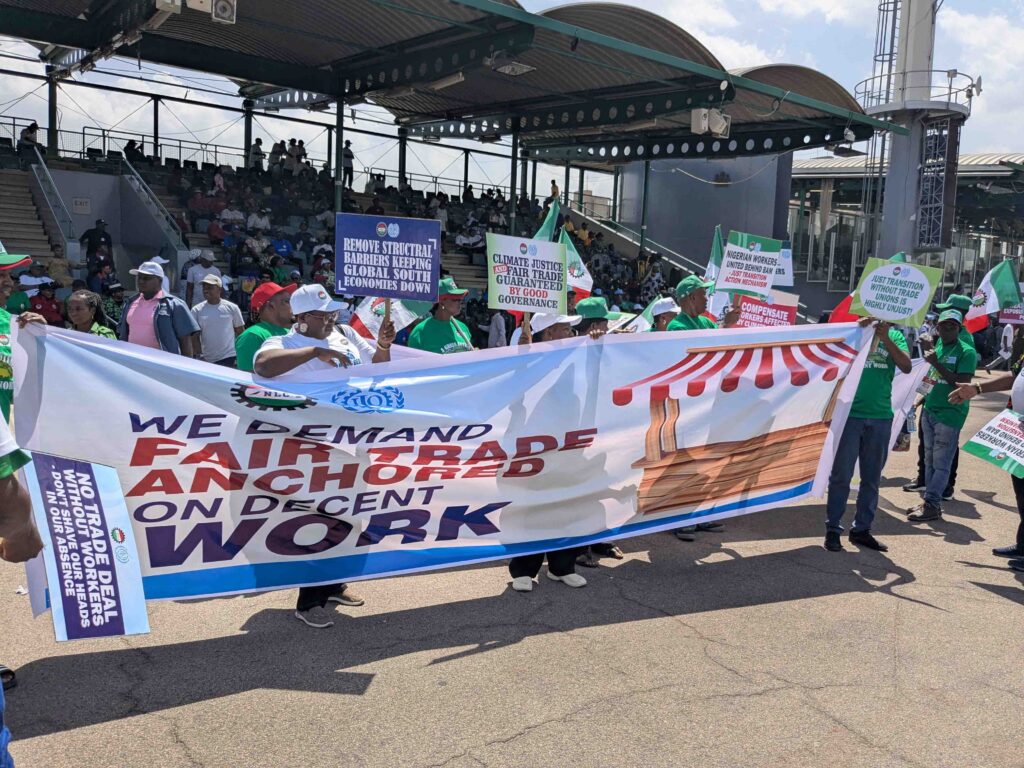
The NLC is right to say that the current wage is a “starvation wage” and is demanding that the government addresses the high cost of living. The labour centre is demanding an immediate review of the current ₦70,000 national minimum wage, which was signed in July 2024, citing rapid inflation and skyrocketing living costs. The labour unions are proposing a new minimum wage of N154,000 and pushing for a 120% salary adjustment.
May Day, 2026 has been scheduled as a protest day against states that have failed to implement the current ₦70,000 minimum wage. We also need to demand a new minimum wage for all.
Workers are at a breaking point, trapped by insecurity, economic hardship, and crumbling values, nonchalant political elites, with no clear way out. Many can’t afford school fees, creating a cycle where their children become vulnerable to exploitation by the same politicians that created the hardship situation. In contrast, the elites’ kids are in top universities. Basic healthcare has become a luxury; people die in under-equipped hospitals. It’s telling that a contractor building a hospital in Akwa Ibom prioritized a mortuary, reflecting the harsh reality of the healthcare sector’s collapse.
It is true that a higher minimum wage would boost purchasing power, benefiting the economy and potentially reducing insecurity and social issues. Logically, it’d be a win-win for the government. But APC’s track record says otherwise – Buhari’s presidency disappointed many, and Tinubu’s policies seem to favour the elite.
The working class needs to see this as a class issue: the ruling elite is using poverty to maintain control. The labour movement, once a champion of workers’ rights, has fallen prey to manipulation. Today, it’s heavily policed and ethicised, a far cry from its apolitical past. The rot that plagued the civil service has infiltrated trade unions, making them a microcosm of the society they serve. Labour leaders openly flaunt their ties to political parties, especially the ruling party. Affiliate unions are divided into political blocs, swayed by the highest bidder. Even state chapters of the NLC brazenly display their political allegiances.
The labour movement used to have a robust and enviable history. The movement was in the forefront for the emancipation of the working masses from the shackles of labour slavery. It was involved in the independent struggle, and was deeply involved in the struggle to rescue us from the yoke of military rule. We can certainly say that the labour movement, in the past, lived up to its objectives and core values.
We saw how Adams Oshiomhole, a former NLC president, aligned the Congress with APC, backing Buhari over Goodluck Jonathan. Ayuba Wabba’s presidency also seemed tied to supporting Buhari.
Under Buhari, NLC acted like APC’s labour wing. But in 2017, workers turned on Oshiomhole at an NLC colloquium, realizing he’d led them astray and wasn’t true to their cause.
The state has deteriorated under APC rule, with institutions crumbling and branches of government reduced to serving the executive’s whims. Problems have mounted beyond PDP’s tenure, and the future looks grim with no clear direction.
Now should be the time for NLC, organised labour, and progressive civil society to courageously challenge misguided policies and rescue the poor labouring masses. The Congress must lead the charge.
Can Joe Ajaero lead the fight for a living wage? Workers need a wage that matches today’s reality. Will Ajaero stand firm or has he been silenced? As they say, “strike the shepherd, scatter the sheep” – is it a case of weak leadership or just not enough fighters? One comrade said, “The harvest is plenteous, but the labourers are few” – are we lacking numbers or grit?
Download our full Socialist Labour May Day 2026 Newspaper with the link below:
https://socialistlabour.com.ng/wp-content/uploads/2026/05/2026-May-Day-Newspaper-1.pdf