

Izielen Agbon
February 28, 2026
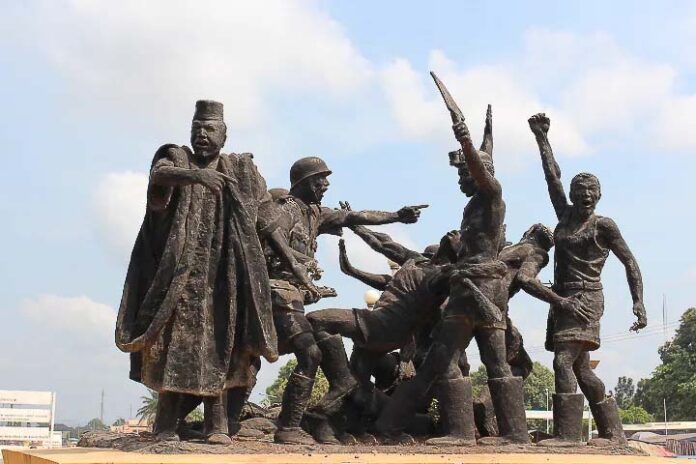
The Iva Valley massacre of November 1949 arose from a rising wave of class struggles from the end of the World War in 1945. These were not restricted to the mines and included the 1945General Strike (lasting 45 days from June 22 to early August 1945). The miners struggles were against the colliery management, the Colonial State and even, at times, their own trade union leaders. The miners introduced imaginative approaches included go slow action and occupations of the mines. Their wives and partners were also involved in supporting protests.
The massacre of 21 miners resulted in mass protests and rioting across the South East. In Owerri 15,000 people protested and a workers’ leader was shot dead. A rally was held in Aba and a march and riot in Port Harcourt where another two workers’ leaders were shot dead by the police. Protests were also held in Onitsha and Calabar. The petite bourgeoisie called for “self-government of Nigeria Now!” The protests were called off by the Zikist Movement after an appeal from the trade union leaders. The commission of enquiry recommended the payment of £400 compensation to the family of each of the murdered coal miners. It also emphasised the need to separate politics from the trade union movement and to need to remove militant or “reckless and self-serving” trade union leaders.
The Colonial State began mining operations at Enugu in 1915. All coal mining activities were under the control of the Railway Department. In 1938, Enugu Colliery was removed from the control of the Railway Department and designated as a separate department. The coal mining operation was not commercially profitable. The problem was a failure to reach output targets due to the miners’ struggles, wagon shortages and increased wages. The low output resulted in losses and deficits. All through the 1940’s, productivity declined while wages rose. For instance, the output per shift dropped from 63.5cwts in 1941 to 31.5cwts in 1945. Daily wages rose from 3s. to 5s.6d. during the same period. In 1949, output per shift was 29.0cwts while daily wages stood at 6s.8d.. The increase in wages was a product of the coal miners’ struggles.
Table 1 : Enugu Colliery : Productivity and Wages. 1938-1949.
| Year | Total Number of Workers | Output per Shift (CWT) | Highest Daily Wages ( s. d.) |
| Jan-Mar 1938 | 2793 | 58.5 | 3 2 |
| Sept-Dec 1938 | 2793 | 51 | 3 2 |
| Sept-Dec 1940 | 2587 | 62 | 3 0 |
| Jan-Mar 1941 | 2244 | 63.5 | 3 0 |
| Sept-Dec 1943 | 2928 | 43.5 | 4 6 |
| Jun-Sept 1945 | 4872 | 31.5 | 5 8 |
| Jun-Sept 1946 | 5082 | 42.5 | 5 8 |
| Mar-Jun 1947 | 5366 | 50 | 6 0 |
| Sept-Dec 1947 | 6060 | 22.5 | 6 2 |
| Jan-Mar 1949 | 6003 | 29 | 6 8 |
Source: Daily Times, June 10, 1950.
In 1944, the Colliery Workers’ Union and the Colliery Surface Union demanded that the wage increase won in 1942 be implemented. The Colliery Workers’ Union represented 920 hewers and 2,470 other underground miners. The other union represented the interests of the 680 surface workers.
These two unions sent letters to the Colliery management and the Enugu labour officer. The Colliery management refused the demand, arguing that there were no funds to pay the wage increase. The labour officer intervened and the trade dispute was referred to arbitration in accordance to Part VIII of the Nigerian General Defense Regulations of 1941 as amended by the Nigerian Defense (Industrial Disputes) (Amendment) Regulation, No.107 of 1942. The arbitrator, Mr. Harold W. Long, made an award in January of 1945.
The Long awards introduced a piece work system under which groups or syndicates of miners would be paid on the basis of work performed as a unit. The surface miners preferred to be paid on a daily rate. Hence, they resisted the imposition of a piece work system. However, hewers and tubmen agreed to experiment with the system under pressure from the union leaders. Soon, the hewers and tubmen were agitating for the elimination of the system because they found out that while the piece work system operated on unit work for unit pay, the Colliery management determined what constituted a unit of work and a unit of pay. The management increased what made up the unit of work for the same pay scale. This was their solution to the problem of falling productivity. The hewers and tubmen wanted a reduction in what made up the unit of work and an increase in the unit of pay.
Management maintained that such changes were its responsibility. Therefore, the underground miners (hewers, tubmen and others) demanded the termination of the piece work system against the wishes of the union leaders and the management. They struggled over the number of units of work performed such that the higher number of units of work recorded compensated for the reduction in pay per unit of work by management. The attacks against the management’s ability to determine how many units of work was actually done led to the collapse of the piece work system.
The management’s response was to treat the hewers and tubmen as having resigned for not abiding by the terms of the Long awards. New workers were hired. However, productivity did not increase as expected because the new workers only worked enough to meet their immediate needs, their reproduction. Hence, the Management re-employed the dismissed workers on a daily rate system. The return to the daily rate system was carried out under an agreement with the non-union representatives of the new workers. The new workers were kept on a separate payroll and a company union was set up for them. The management treated this company union as the only representative organ of the underground workers thereby imposing new divisions on the miners.
Following the Harragin Commission’s award to state workers across British West Africa in 1946, the Colliery Workers’ Union requested that the Colliery management should ask the Colonial State to provide information on how the new wage scale would affect miners. The management ignored the request. Therefore, the union called for a ‘go slow’ strike. The ‘go slow’ strike reduced productivity to a minimum and Management found that the company union had no influence over the miners. So, the management sought the help of village elders and clan councilors from the Enugu vicinity. Despite the pleas of the village elders and clan councilors, the miners continued their ‘go slow’ strike.
Faced with declining output, the management finally called in the Secretary of the Colliery Workers’ Union who got the miners to terminate their strike. Later, the strike was resumed when it was discovered that the management had no intension of paying the Harragin awards. An arbitrator was appointed upon the intervention of the Enugu labour officer and the strike was called off again.
In December of 1947, an agreement was reached between the management and the Colliery Workers’ Union. Under this agreement, wages were increased for all miners in accordance to the Harragin awards. The wage increases were to be back dated to January of 1946 and management had to pay £150,000 in arrears. However, this was not enough as the union and management had different interpretations of the Harragin awards. The union wanted more arrears for numerous categories of miners. Management refused to pay any more arrears. So, in December of 1948, the union initiated a ‘go slow’ strike.
A conciliator was appointed when the labour officer intervened. The conciliator agreed that more arrears were due Screen and Haulage workers, Screen Foremen, Token Collectors, Token Hangers, Token Shouters and Token Clerks. These workers were to be paid their full arrears no later than March of 1949. A similar time limit was imposed by the conciliator for the payment of all arrears on overtime. Finally, the conciliator designated the Colliery Workers’ Union as the true representative organ of the miners and demanded that the management grant full recognition to the union. Management did not implement the above agreement which led to more industrial conflicts in the coal fields. The continuing conflicts forced the Colonial State to intervene and set up a Whitley Council for the coal mines.
The Whitley Council was established in February of 1949. Under the new negotiation machinery, bi-monthly meetings were to be held by the Personnel manager and Union leaders. Any unsettled matters were then referred to a meeting attended by the Personnel manager, Union leaders and labour officers from the labour department. Matters not agreed upon were next referred to the Colliery management. If any disagreement remained, the issue was then placed before the Whitley Council or a conciliator. The Whitley Council consisted of the Colliery management, Union leaders, the Personnel manager and the labour officer.
The Whitley Council held its first meeting on February 22, 1949, and its second on April 13 of that year. It was evident that tensions between the miners and management, were still high. Before the third meeting of the council, the hewers embarked on a ‘go slow’ strike. The Union leaders claimed that the strike was a wildcat strike carried out autonomously by hewers outside the negotiation machinery accepted by them. Therefore, they did not know what the hewers were demanding. The hewers felt that the union leaders were not representing their interests. The union leaders were always attending meetings and had lost touch with the particular demands of hewers.
The hewers put forward their particular demands by initiating a ‘go slow’ strike. The hewers’ demands were:
- Hewers should be paid 4s. per day rather than 3s. per day.
- Seniority pay for all underground workers other than hewers who already had this privilege.
- Underground allowance paid to all Nigerian miners should be increased from 4d. to 12d. per day since European miners were paid 2s. per day.
- Transport allowance should be paid to all Nigerian miners.
- Tubmen and hewers should be upgraded.
- All victimization of union activists should stop, and paragraph 36 of the labour code should be implemented.
- All past wage claims, already agreed to by management, should be paid immediately.
- A 44 hours week should be established and used as the basis of computing overtime instead of the present system of using 45 hours.
The colliery management agreed to pay seniority pay to all underground miners and to stop all victimization. However, it failed to reach an agreement with the hewers’ representatives on all other demands. The hewers were dissatisfied. They wanted to be upgraded because other miners had been upgraded after the Harragin awards. Therefore, they initiated a series of demonstrations outside the offices of the colliery management and rejected all attempts at mediation by union officials.
This was how the hewers chose to negotiate because experience had shown that their economic gains were the product of their power as well as their ability and willingness to struggle, not the good nature of the colliery management or the negotiating skills of the trade union leaders.
The demonstrations continued until October of 1949. For example, on October 25, 1949, 100 hewers demonstrated outside the offices of the Colliery manager and the Chief Accountant. The next day another 100 hewers demonstrated outside the office of the Personnel manager. Then, they stormed the office of the Assistant Personnel manager, demanding the immediate implementation of their demands. The Colliery manager was shouted down when he told them to leave. So also was the secretary of the Colliery Workers’ Union who begged, on his knees, for the demonstrating hewers to leave the office.
The demonstrating hewers left after a member of their executive committee spoke to them. The hewers had elected a hewers’ executive committee after their July ‘go slow’ strike. On November 1, 1949, a meeting was held between the union leaders, the colliery management and the hewers’ executive. The hewers’ executive demanded the immediate payment of all seniority pay arrears from 1946 and 1947. Union leaders supported this demand while the colliery management rejected it. A trade dispute was declared, and the Colonial State intervened by establishing an Enugu Colliery Board.
The Enugu Colliery Board was made up of State officials and members of the rising Nigerian petite bourgeoisie. The Board held its first meeting on November 7, 1949. That night, the hewers initiated a ‘go slow’ strike and demanded the immediate payment of all seniority pay arrears, the upgrading of hewers and the provision of housing and travelling allowances. Mr. L. P. Ojukwu (of the NCNC and ACB) and Mr. Obioha, who were members of the Board, intervened. They held a meeting with the secretary of the Colliery Workers’ Union.
On November 9th, they asked the hewers to resume normal work and send their demands to the Whitley Council. The hewers refused and the ‘go slow’ strike continued with hewers filling one tub per shift. Management reacted by dismissing 50 hewers and serving 250 other hewers with dismissal warnings. There was a total of 1,335 hewers working in the mines at this time and management dismissed 50 hewers a day between the 9th and 13th of November. On November 10th, following the dismissal of 50 hewers, the hewers changed the ‘go slow’ strike into a ‘sit down’ strike by occupying two pits. The next day, the hewers’ wives started demonstrating in front of the offices of the colliery management. The women demanded that their husbands be paid all arrears. Meanwhile, more hewers were joining the ‘sit down’ strike.
On November 13th, 1949, the Chief Commissioner of the Eastern provinces called a meeting of State officials at the Government’s Lodge in Enugu. The State became an active participant in the industrial dispute. In the meeting, it was decided that there could be no conciliation in the coal mine dispute independent of the State, as the State. It was admitted that there was a high accident rate in the mines and health and safety conditions were poor. In 1948, a total of 1,008 underground accidents had occurred, resulting in the death of two miners, the permanent incapacitation of 50 and the temporary incapacitation of 956. The meeting participants concluded that a Ministry of Labour needed to be established to deal with the implementation of health and safety measures. They also concluded that the hewers’ demands for arrears payment were just. However, they noticed that the arrears could not be paid because of the poor financial situation of the Colliery. Attention was then given to ways in which Statutory Boards and permanent conciliation machinery could be established in the mines. The hewers’ ‘sit down’ strike was not discussed directly.
On November 15th, 1949, the hewer’s wives demonstrated at the offices of the colliery management. Later, they marched to the Colliery manager’s home and carried out minor damage before the police could disperse them. After this action, they began a running street battle with the police. Stones were thrown at the police from a safe distance. The women broke the windows of the Secretariat Buildings as the police began using tear gas. The next day, the women went to the Obwetti mines, where the ‘sit down’ strike was in progress and attacked officials of the colliery management.
The Colonial State reacted by evacuating all Senior Service staff members and their families from Enugu. Meanwhile, Mr. P. F. Grant of the Enugu Local Authority held a public meeting with the women and succeeded in calming them down. Another public meeting was held with the women on November 17th, in the presence of Mr. V. K. Johnson, the Resident of Onitsha province. The women’s initiative and power in asserting themselves set the Colonial State in motion. This was because the women’s action shattered the divisions between the point of production and the point of reproduction as well as those between them, as unwaged workers, and their striking husbands, as waged workers. From the State’s point of view, the women’s initiative circulated the struggle beyond the terrain controlled by the Colonial State, as the employer. Since the struggle was now at the level of the social factory, the Colonial State, as the State, took control of the overall efforts to manage the conflict.
On the night of November 17, 1949, the Chief Commissioner called another meeting in his bedroom at the Government Lodge. In this meeting, the representatives of the Colonial State, as the State, and the Colonial State, as the employer, gathered.[1] They decided that two basic approaches should be used to terminate the hewers’ ‘sit down’ strike. First, attempts were to made to find suitable mediators that could convince the hewers to terminate their strike. Early on November 15th, the Colliery manager had rejected offers by the Ngwo Clan Council to act as a mediator. The Ngwo Clan Council also offered its services to the Secretary of Finance for the Eastern provinces as well as to the Colliery’s Personnel manager on November 16th, but the offers were rejected on both occasions.
The Chief Commissioner had also rejected the request of the Senior labour officer for permission to contact and hold talks with the Hewers’ executive on November 16. Now, it was decided that the Resident of the Onitsha province would contact the Ngwo Clan Council on the next day and ask them to convince the hewers to terminate their strike. Secondly, it was decided that 900 police reinforcement from other parts of the Eastern provinces should be brought to Enugu. This decision was taken after those at the meeting concluded that the hewers’ strike was really political agitation. The Chief Commissioner claimed that there were political agitators, waiting in the background and ready to take advantage of the hewers’ struggle for their own subversive purposes.
The Assistant Commissioner of Police reported that 30 cases of explosives had been appropriated from the Colliery magazine by members of the Zikist movement. Eleven cases were yet to be recovered. Based on this information, the meeting participants decided to remove all explosive materials from the distribution stores at the Obwetti and Iva Valley mines on the next day. The Assistant Police Commissioner presented himself and the Colliery manager to handle the planned operations. Armed policemen were to be used and the November 18th operations were planned as follows:
• Mr. F. S. Phillip (Senior Superintendent of Police) was to go to Obwetti mine with 25 armed policemen.
• Mr. E. J. R. Ormiston (Senior Assistant Superintendent of Police) and Mr. O. P. S. Jones (Assistant Superintendent of Police) were to proceed to Iva Valley Store No.l with 50 armed policemen.
• Mr. H. J. W. Watkins (Assistant Superintendent of Police) and Mr. R. A. Brown (Assistant Superintendent of Police) were to proceed to Iva Valley Stores No.2 and No.3 with 50 armed policemen.
It seems the meeting participants expected resistance, given the number of armed policemen ordered to perform a simple operation like the evacuation of explosive materials. Furthermore, they decided that the colliery management should proceed with a lock-out, once the explosive materials had been removed from the mine premises.
On November 18, 1949, the planned operations began. The Resident of the Onitsha province sought the help of the Ngwo Clan Council and later went to the home of the Colliery manager. The explosives evacuation operations went as planned, although Mr. Brown accompanied Mr. Phillip to Obwetti mine contrary to orders. All the three explosives evacuation operations were initiated simultaneously. The operations at Obwetti mine and Iva Valley No.2 and No.3 were successfully carried out. Hewers were engaged in the ‘sit down’ strike underground while other miners stood talking and doing no work above the surface.
At Iva Valley Store No.l, the operation was handled with excessive force and much bloodshed. Mr. Ormiston and Mr. Jones had arrived at the store with the 50 armed policemen at 11.00 am. There were a few miners standing around and talking. The Colliery management officials asked these miners to load the police vehicles with the explosive materials. The miners refused. The officials then decided that there were too much explosive materials in the store to be transported by road. They concluded that the railway line, which ran right to the store, was a more appropriate transportation method for evacuating the explosive materials.
Therefore, they stopped all evacuation activities and telephoned the Colliery manager for a railway engine and a railway wagon. The Colliery manager notified the Assistant Police Commissioner who agreed to change the plan. Meanwhile, the two officers and 50 armed policemen stood around the Iva Valley Store No.l. Soon, more miners gathered and by 1.00 pm when the railway engine and wagon arrived, there were 1,500 miners present. The miners began chanting and singing when they found out that the Colliery management planned to initiate a lockout after the explosive materials had been removed. Mr. Ormiston then informed the Assistant Police Commissioner that the operations could not be carried out.
The Assistant Police Commissioner contacted the Chief Commissioner, who ordered Messrs. Phillips, Brown and Watkins to join Mr. Ormiston at Iva Valley Store No.l with a reinforcement of 75 armed policemen. The reinforcement arrived at Iva Valley Store No.l at 1.30 pm and Mr. Phillips took command of the combined force. He also concluded that the operations could not be carried out under the prevailing conditions. However, he ordered his men to take up positions on the hillside overlooking the miners. According to Mr. Phillips, the miners were chanting, singing and dancing ‘war dances’ as well as exhibiting a menacing attitude, so he ordered his men to open fire on the unarmed miners. All the 125 policemen fired their weapons numerous times. Mr. Brown could only obtain a cease fire by going down the line and knocking up the rifles of individual policemen. When the smoke cleared, 21 miners were dead and 55 wounded.
No policeman was hurt and neither had any of them been threatened. The Assistant Police Commissioner later claimed that three of the policemen were attacked by some miners before the shooting started. Immediately after the shooting, the Chief Commissioner of Police had released a report stating that armed miners had attacked the policemen who had to open fire in self-defense. This report was false. On November 20, 1949, the Colonial State appointed the Fitzerald Commission to look into the shooting incident. The next day the Secretary to the Colonial State forced the Colliery manager to disembark from a U.K. bound ship which he had boarded in Port Harcourt. The Colliery manager had run to Port Harcourt, after the massacre, with the intension of escaping to Europe.
The Nigerian response to the Enugu massacre has always been presented as one in which all Nigerian classes were temporarily united. Describing this response, Nduka Eze, the Zikist trade union leader, said:[2]
“The radicals and the moderates, the revolutionaries and the stooges, the bourgeoisie and the workers sank their differences, remembered the word “Nigeria” and rose in revolt against evil and inhumanity,”
If the above was true, then it should be pointed out that the Nigerian petite bourgeoisie and working class revolted against this colonial evil and inhumanity in quite different ways.
Upon the Enugu massacre, the Nigerian newspapers denounced the shooting. On November 20th, representatives from the two petite bourgeois parliamentarian parties (the NCNC and the NYM) met at the home of Dr. Maja and formed an organization called the Nigerian Emergency Committee. Dr. Maja was elected as the chairman.[3] Two days later, delegates from the Nigerian Emergency Committee arrived by air and road to Enugu to investigate the shooting. The investigation team found that the initial statements of the Colonial State concerning the shootings were false. Therefore, the Nigerian Emergency Committee demanded a commission of enquiry. The investigation team convinced the miners to return to work on November 30th. It held a rally, protesting the shooting, on December 8th after the Colonial State had lifted its state of emergency. Dr. Maja proclaimed, during the rally, that ‘self-government for Nigeria Now!’ would become the new slogan of the decolonialization movement.
Thus, the petite bourgeoisie representatives attempted to channel the anger of the rally participants into the parliamentarian struggle for political independence. On December 12th, the Fitzgerald Commission commenced sitting at Enugu. Until its adjournment to resume sitting, in camera, at Westminster in London on January 5, 1950, the Nigerian Emergency Committee presented numerous evidence before the commission. The commission published its report in June of 1950.
On November 20th, two days after the Enugu massacre, Mr. S. O. Masi and Mrs. M. Ekpo, leaders of the Zikist Movement in Aba, called a workers meeting and told the truth about the Enugu shootings to the gathered workers. The Resident of Owerri province heard about the meeting from police intelligence. He ordered police re-enforcement in anticipation of a riot. He also summoned Aba leaders, including the Zikist leaders, and informed them of the Colonial State’s version of the Enugu shootings. The leaders were threatened with police arrest if they attempted to spread ‘rumours’. The Zikist leaders pointed out that this was an act of intimidation. They stated that they would only tell the truth about Enugu. So, the Resident prepared for the worst. He was not disappointed.
The response of the working class to the Enugu massacre was regional and directed at rupturing the circuit of the reproduction of labour power. The workers’ response began on November 23th when Mr. Thompson, the Aba District Officer, was attacked with stones and wounded while driving around town. The Resident of Owerri province then proceeded to evacuate all women and children from the area, 3,000 workers gathered and commenced to attack State owned properties. They also expropriated approximately £8,000 worth of commodities from the European shops. European cars and homes were stoned.
Soon, the police arrived and stormed the workers who retaliated by stoning and wounding many policemen. There were 15,000 workers involved in the street battles with the police by this time. It took numerous baton charges before the police could disperse the workers. The dispersed workers just reassembled at another section of the town. Baton charges were mounted on the revolting workers, again and again, but the results were the same. It became obvious to the police that they could not control the streets, despite the baton charges and casualties. So, Mr. England, who was in charge of the police force, called seven armed police that had been put in reserve. The seven policemen were ordered to fire warning shots, but this had no effect on the workers. Mr. England then took a rifle and shot down a workers’ leader in the crowd. The workers’ crowd was thus broken up permanently. One worker was dead, and another had been wounded by gunshots while expropriating commodities.
Workers’ expropriation of commodities was concentrated at the colonial companies of G. B. Ollivant and the Compagnie Francaise de L’Afrique Qccidentale (C.F.A.O). These companies controlled the palm produce export market and the import market in Eastern Nigeria. From the workers’ point of view, commodity expropriation could be seen as the direct appropriation of the means of subsistence without the mediation of money. This meant that the reproduction sphere was temporarily ruptured and restructured. The direct restructuring of the reproduction sphere had material and phycological benefits for the workers who participated in it. A hundred more-armed policemen were deployed to Aba on November 25th and this show of force brought the Aba revolt to an end.
In Port Harcourt, workers attempted to march from Roxy Hall to the Resident’s house on November 24th. They were attacked by the police and dispersed. Commodity expropriation started on the 25th of November as G. B. Ollivant and C.F.A.O. stores were attacked. The police charged the workers with batons and the workers responded by stoning them. One Senior Superintendent of Police had an ear torn off and other policemen were wounded. The police fired warning shots and the workers dispersed, only to re-assembly again. Numerous baton charges were executed by the police, but, like in Aba, these did not yield any results. So, the Senior Superintendent of Police ordered that one of the unarmed workers’ leaders in the crowd should be shot. The workers’ leader was promptly killed. An Assistant Superintendent of Police also shot and killed another workers’ leader during a workers’ attack on the Port Harcourt court house.
In Onitsha, November 25th was declared as a day of mourning. The Resident of Onitsha province had already received news of the Aba and Port Harcourt revolts. So, he had police reinforcement flown in from Kaduna on the 25th. On the 26th, the Colonial State declared a state of emergency in the Eastern provinces. Despite this, the workers attacked the police on that day and commenced commodities expropriation. G. B. Ollivant and C.F.A.O. were targeted. Police baton charges failed to empty the streets. One boy, drawing water, was shot by policemen protecting C.F.A.O. properties from being expropriated. In Calabar, workers also revolted and operations involving the expropriation of commodities were carried out. Police and workers battled for many hours. Finally, workers were dispersed when the police fired numerous warning shots. The leaders of the Zikist Movement called off the workers’ revolt in the Eastern provinces on November 28th, when the trade union leaders appealed to them. In November 1949, after the Enugu shootings, the Trade Union Congress (TUC) and the Nigerian National Federation of Labour (NNFL)[4] established the National Labour Committee (NLC) to present evidence to the Fitzgerald Commission.
The workers’ response to the Enugu shootings was quite different from that of the petite bourgeoisie. While workers revolted and expropriated commodities, the petite bourgeoisie agitated for a commission of enquiry. The workers’ revolt was anti-colonial in nature and exhibited strong workers’ solidarity. The failure of the revolt to spread beyond the Eastern provinces was due to ethnic and organizational divisions in the ranks of the trade union leaders. Despite this, Nigerian workers showed strong resistance to the Colonial State’s tactic of containing their struggles through the use of violence and coercion. The political leadership provided by the Zikist Movement helped mobilize the workers’ resistance. Hence, the Zikist Movement was banned in 1950 and the Colonial State spent the next few years eradicating its members from the trade union movement and dismantling the organization by jailing its leaders on superficial charges.
The Fitzregald Commission’s recommendations concentrated on the problem of managing the workers’ struggles for economic self-development and thereby reducing its effect on the decolonialization movement. The problem was posed thus:[5]
“We have emphasized the necessity of isolating as far as possible, trade disputes from political questions.”
In order to achieve this separation of politics from industrial disputes, the Fitzregald Commission recommended that the Labour Department should be converted into a Ministry of Labour with complete control over all trade disputes. The Colonial State should aid this process by overhauling the Nigerian trade union movement. The report suggested that Nigerian trade unions should be built along the lines of the Native Authorities and not those of the British trade unions. In order to achieve this, the State must remove reckless and self-serving trade union leaders. The ability to scream about ‘imperialistic exploitation’ or similar phrases should not be allowed as a criterion for trade union leadership. Responsible trade union leadership, with the confidence of the workers and a Native Authority structure, would make Nigerian trade unionism work for the mutual benefit of the Nigerian workers and Colonial Capital.
The commission further recommended that a Statutory Board of management should be created for all statutory corporations. So also, should Conciliation Boards. The negotiation mechanism for trade disputes between workers and employers should include a Joint Negotiation Committee and a National Reference Tribunal. The Industrial Boards and Whitley Councils should remain. All these institutions would help provide the machinery for handling industrial disputes without resort to the provisions of the Trade Disputes Arbitration and Enquiry Ordinance of 1944 which had set up other machinery for managing the workers’ struggles.
Thus, like every other commission since the Tudor Davies Commission of 1946, the Fitzregald Commission sought ways in which the struggles of the Nigerian working class could be institutionalized and contained. However, the commission was aware of the failure of past negotiating institutions and machinery set up by the colonial State. The commission attributed these failures to the problems in Nigerian trade unionism and the tendency for industrial disputes to become generalized into political movements. It attacked the problem directly:[6]
“We realise, of course, that trade disputes cannot altogether be divorced from politics; there are times when those disputes will develop into political disputes, in which case the political side becomes paramount and control must pass from the Ministry of labour to the political administration. There are other times when the political and industrial aspects are so closely linked together that there must be perfect co-operation.”
When workers’ struggles become generalized into political movements, the political interests of the Colonial State, as the State, must become supreme. In such cases, the commission recommended the use of the State’s tactic of violence. It wrote:[7]
“If this (the coal miners’ strike) had been a political disturbance, we might have had no criticism to offer on the manner in which it was dealt with by that competent administrator, the Chief Commissioner of the Eastern Provinces,”
Thus, the use of coercive force by the State against workers engaged in political struggles against the colonial social relations was condoned. However, there remained the problem of separating trade disputes from politics when Nigerian workers exhibited an inherent tendency towards using political methods to resolve industrial conflicts. This problem was to be solved by directing the political aspects of trade disputes towards the parliamentarian road to political independence under the political dominance of the Nigerian petite bourgeoisie. Therefore, the State should help the petite bourgeoisie by giving this class a political programme that would be acceptable to them.
The Commission warned that success depended on keeping an eye on the struggles of the working class for their economic self-development.[8]
“The danger is – indeed it is a danger which experience teaches us is ever present – that the influence that this class has or will have on the majority of the population is under-estimated.”
The Commission recommended that a £400 compensation be paid to the family of each of the murdered coal miners. It attributed the massacre to the inadequacies of the Secretary of the Colliery Workers’ Union and an error of judgement on the part of Superintendent Phillips who had ordered the shootings.
The recording of the Socialist Labour public meeting on this topic is available here:
[1] Meeting participants included the Chief Commissioner, the Secretary of Finance for the Eastern provinces, the Assistant Commissioner of Police, the Resident of Onitsha province (Mr. V. K. Johnson), the new labour officer in Enugu (Mr. Honey), the Colliery Manager (Mr. Bracegindle) and the Colliery Board Chairman (Mr. Raeburn).
[2] Cohen, Robin. ‘Labour and Politics in Nigeria, 1945-71.’ Op.cit. p.74.
[3] Other members of the Nigerian Emergency Committee included Mbonu Ojike, S. O. Gbadamosi, Rotimi Williams, Ozumba Mbadiwe, F. Anyiam, the Odemo of Ishara, A. O. Thomas, Oged Macaulay, G. B. Okeke, H. O. Davies, Nduka Okoro and Dr. Olorun-Nimbe.
[4] The Nigerian National Federation of Labour (NNFL) was formed by militant trade union leaders such as Messrs. Imoudu, F. O. Coker and Nduka Eze after moderate trade union leaders had forced the disaffiliation of the TUC from the NCNC in 1948. These militant trade union leaders broke away from the TUC and formed a committee of trade unionists which later expanded to form the NNFL.
[5] Daily Times, June 17, 1950.
[6] Daily Times, June 17, 1950.
[7] Daily Times, June 10, 1950.
[8] Daily Times, June 10, 1950.