
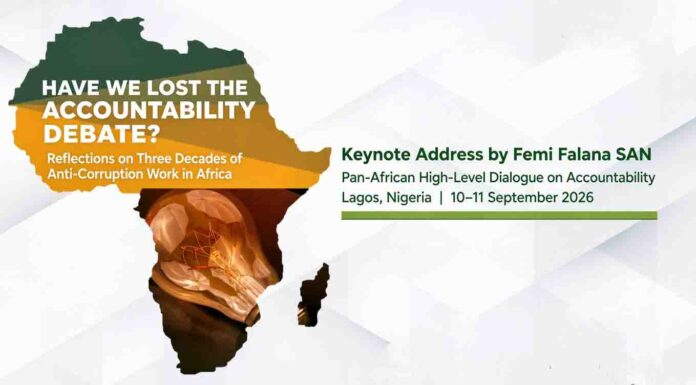


By Femi Falana SAN
(Being the text of the keynote address delivered at the Pan-African High-Level Dialogue on Accountability in Lagos, Nigeria, 10-11, September 2026)
INTRODUCTION – THE WRONG QUESTION
The organisers of this dialogue have posed a question which is both timely and provocative: Have We Lost the Accountability Debate? My answer is that we have not lost the debate. Rather, we have lost sight of the true meaning, purpose and ownership of accountability. For nearly three decades, African countries have established anti-corruption agencies, enacted anti-corruption legislation, ratified international and regional conventions, created parliamentary committees, strengthened financial intelligence mechanisms and invested considerable resources in the prosecution of corruption. Yet, despite this impressive architecture, corruption remains deeply entrenched in the political and economic life of the continent.
The question, therefore, is not simply why corruption persists despite the existence of anti-corruption institutions. The more fundamental question is: who is responsible for holding those who exercise political and economic power accountable? There is a tendency to speak of corruption as though it were principally a problem for governments to solve. This is where I believe the accountability debate has gone wrong. The victims of corruption are the people. When public money is stolen, it is the citizen who loses the hospital that should have been built. It is the child who attends a school without adequate facilities. It is the worker who remains unemployed because resources meant for economic development have been diverted. It is the family that cannot obtain decent housing despite the existence of laws and institutions specifically established to facilitate affordable housing. It is the community that lacks potable water, electricity, roads and other basic infrastructure because funds appropriated for those purposes have disappeared.
It is pertinent to point out that Africa has not completely lost the accountability debate. It is that we have allowed accountability to become bureaucratised, institutionalised and removed from the people whose resources and rights are being abused. Thirty years of anti-corruption institutions should not produce a passive citizenry waiting for government to fight corruption on its behalf. They should produce a more organised, informed and assertive citizenry capable of demanding accountability from government and, where necessary, from the institutions established to enforce it. The challenge before us is therefore to reclaim accountability as a democratic weapon of the people.
THE POLITICAL ECONOMY OF CORRUPTION
The discussion on corruption must also confront the economic and political system within which corruption occurs. It is not sufficient to treat corruption simply as the product of individual greed or the moral failure of particular public officials. Corruption must be examined within the structure of the capitalist system and, more particularly, within the different forms in which capitalism operates across the world. Corruption is not peculiar to Africa, nor is it an exclusively African phenomenon. It exists in virtually every capitalist society. The difference, however, lies in the capacity of institutions to detect, expose and punish corrupt practices and to ensure that no individual, irrespective of his political or economic status, is permitted to place himself above the law.
In developed capitalist states, the existence of corruption does not necessarily mean that the institutions of accountability have completely collapsed. Public officials, corporations and other powerful individuals may engage in corrupt practices, but where institutions are sufficiently strong and independent, exposure can lead to investigation, prosecution and punishment. Political influence may exist, economic interests may seek to protect themselves, and attempts may be made to conceal wrongdoing, but the institutional framework is sufficiently resilient to ensure that corruption can ultimately be brought before the law.
The important point is therefore not that developed capitalist states are free from corruption. They are not. The difference is that the institutions of the State possess a greater capacity to survive attempts at capture. A powerful politician may attempt to interfere with an investigation, but an independent investigative institution may continue the investigation. A wealthy businessman may attempt to influence the media, but independent journalists may continue to expose the misconduct. A public official may attempt to influence a prosecution, but an independent prosecutor may proceed with the case. And where the matter reaches the courts, judicial independence provides an additional institutional barrier against political interference. In such systems, the rule of law is intended to operate as a constraint upon power.
The situation is substantially different in peripheral capitalist societies, particularly where political institutions remain weak, economic inequality is extreme and the distinction between political power and private economic interests is blurred. In these societies, the political class and the economic elite frequently operate within interconnected networks. Political office provides unrestrained access to public resources, while economic power provides political influence. Business interests may depend upon government patronage, government officials may depend upon business interests for political financing, and political connections may determine access to public contracts, licences, concessions and other economic opportunities.
Capitalism may create opportunities for the accumulation of wealth. Political democracy may create opportunities for the exercise of public power. But neither can be legitimate where wealth and power place individuals beyond the reach of the law. The ultimate safeguard is therefore the rule of law backed by strong, independent and accountable institutions. Where such institutions exist, corruption can be exposed and punished regardless of the status of the offender. Where they are weak, the law becomes a matter of convenience, accountability becomes selective, and impunity becomes an attribute of political and economic privilege. That is the fundamental institutional challenge which the African anti-corruption movement must confront.
AFRICA’S STOLEN WEALTH IN WESTERN FINANCIAL INSTITUTIONS
The history of corruption in Africa cannot be properly understood by examining only the petty bribe demanded by a public official or the small amount of money diverted by an individual civil servant. The continent has experienced a far more destructive form of corruption: grand corruption involving heads of State, ministers, senior public officials, politically connected businessmen and networks of beneficiaries who have treated public resources as instruments of personal enrichment. The stories of Sani Abacha in Nigeria, Mobutu Sese Seko in the former Zaire (now Democratic Republic of Congo), Yahya Jammeh in The Gambia, Teodoro Obiang Nguema Mbasogo and his family in Equatorial Guinea provide important lessons about the nature of grand corruption in Africa.
These dictators were fully backed by the governments of western countries in unleashing violence on the people. They stole their countries dry and warehoused the loot in the banks of Western countries. All the stolen loot of the dictators is kept in the banks of western countries. In particular, the funds were kept in the coded accounts in Switzerland and other banks. Western governments derive maximum benefits from the looted wealth of African people. Hence, they have frustrated the recovery of the looted wealth. In view of the success recorded in the recovery and repatriation of the Abacha loot, other victim countries in Africa ought to follow the Nigerian model.
Multinational corporations have continued to repatriate profits running to billions of dollars under the pretext that African governments are in search of foreign investments. In the oil producing communities in Nigeria, gas is flared in a manner that the health of the people is endangered. Instead of protecting the health of the people, the government collects taxes from oil companies that engage in the flaring of gas. Illegal mining of gold and other solid mineral is being perpetrated in Africa by local and foreign miners with the connivance of government officials. Licences to mine minerals are given out to top public officers and private companies. The most dangerous aspect of the criminal enterprise is the involvement of terrorists and bandits in Nigeria, in the Sahel and in the Democratic Republic of the Congo in mining.
Addressing government authorities and diplomats at the presidential palace in Kinshasha on January 31, 2023, the late Pope Francis delivered a forceful message: “Hands off the Democratic Republic of the Congo! Hands off Africa! Stop choking Africa, it is not a mine to be stripped or a terrain to be plundered.” He stated that after centuries of brutal political exploitation, the continent was now subjected to an “economic colonialism that was equally enslaving,” which strips local populations of their agency and wealth. The pontiff remarked that the relentless global demand for minerals—such as diamonds, copper, cobalt, and lithium—has fueled vicious local conflicts and forced horrific labor conditions, declaring that “the poison of greed has smeared its diamonds with blood.”
On 31 May 2025, Mr. Antonio Pedro, the Deputy Executive Secretary of the Economic Commission for Africa (ECA) said that “Africa is experiencing significant losses, estimated at around $40 billion annually, due to illicit financial flows (IFFs) in the extractive sector. Such financial losses not only hinder developmental progress but also exacerbate economic injustices, depriving African populations of access to essential resources and underscoring the connection between IFFs and the pursuit of reparatory justice. He argued that IFFs in the extractive sector were one of the symptoms of a serious structural problem compounding Africa’s development, i.e. its excessive dependence on the export of raw materials, an extractive model and construct inherited from colonial times. He noted that exporting raw materials was exporting jobs, a luxury that the continent cannot afford given the need to create at least 20 millions jobs annually for the youth. As such, addressing IFFS and its root causes should be at the centre of Africa’s development policy and action.”
In the same vein, the Collaborative Africa Budget Reform Initiative, an international organization for public financial management has stated that “Over the past five decades, Africa has experienced an estimated loss exceeding $1 trillion in illicit financial flows (IFFs) —an amount roughly equivalent to the total official development assistance received during the same period. These flows drain Africa’s resources, crippling development and deepening inequality. They steal capital meant for hospitals, schools, and infrastructure, leaving countries with weaker economies and fewer public services. By fuelling corruption and tax evasion, IFFs undermine governance and erode trust in institutions. The overall impact is a cycle of poverty and inequality, as precious resources are siphoned off and development efforts are stifled, leaving African nations with fewer means to achieve sustainable growth and stability.
The United Nations Office of Special Adviser on Africa produced a report in November 2022 which stated that “Illicit financial flows pose a critical challenge to African countries, as IFFs deny countries the opportunity to generate the revenues required for them to meet their expenditure needs and to fund long-term development plans. UNCTAD has put the magnitude of IFFs in Africa at an average of $88.6 billion per year, which represents about 3.7% of the continent’s total Gross Domestic Product. Curbing IFFs can reduce the region’s financing gap by 33%. IFFs drain foreign exchange reserves, affect asset prices, distort competition, and undermine the capacity of countries to maintain economic and financial stability. Consequently, African countries are constrained in meeting commitments made under various regional and international frameworks, including the 2030 Agenda for Sustainable Development and Agenda 2063.
This report is focused on IFFs linked to aggressive tax planning and other illegal commercial practices in the context of Africa. Commercial practices constitute the largest source of IFFs from Africa (65%), followed by crime (30%) and corruption (5%). The report provides a broad overview of the scale and distribution of IFFs in Africa; discusses different forms of IFFs that arise from tax and illegal commercial practices; and reviews current initiatives for combating tax and commercial-related IFFs in Africa. The report provides the conclusion and policy recommendations for combating tax and commercial IFFs in Africa.”
These reports have been corroborated by the Chairman of the Independent Corrupt Practices and Other Related Offences Commission (ICPC), Dr. Musa Adamu Aliyu, SAN, has cautioned, in November 2025, that Africa risks losing its future to the growing convergence of cybercrime, corruption, and illicit financial flows (IFFs), which drain more than $80 billion from the continent every year. Delivering the keynote address at the Realnews 13th Anniversary Lecture Series in Ikeja, Lagos, Dr. Aliyu said Africa’s developmental ambitions—including the African Union’s Agenda 2063 would remain unattainable unless governments take decisive action to strengthen cybersecurity, modernise regulatory frameworks, and close the loopholes that enable massive illicit outflows. Speaking on the theme “Cybersecurity, Illicit Financial Flows and Achieving Agenda 2063 in Africa,” the ICPC Chairman noted that the digital age has created new pathways for corruption and criminal innovation. He disclosed that in one investigation, ICPC uncovered falsified expense claims by a multinational company operating in Nigeria—funds he said were enough to “fully rehabilitate at least 10 teaching hospitals.”
At this juncture, we are compelled to call on all African government to comply with article 21 of the African Charter on Human and Peoples Rights which provide as follows:
- All peoples shall freely dispose of their wealth and natural resources. This right shall be exercised in the exclusive interest of the people.
- In no case shall a people be deprived of it. In case of spoliation the dispossessed people shall have the right to the lawful recovery of its property as well as to an adequate compensation.
- The free disposal of wealth and natural resources shall be exercised without prejudice to the obligation of promoting international economic cooperation based on mutual respect, equitable exchange and the principles of international law.
- States parties to the present Charter shall individually and collectively exercise the right to free disposal of their wealth and natural resources with a view to strengthening African unity and solidarity.
- States parties to the present Charter shall undertake to eliminate all forms of foreign economic exploitation particularly that practiced by international monopolies so as to enable their peoples to fully benefit from the advantages derived from their national resources.
CITIZENS OWNED ACCOUNTABILITY BEFORE ANTI-GRAFT AGENCIES
It is important, at this point, to correct a misconception that has gradually taken root in our public discourse: that the fight against corruption in Africa began with the establishment of the anti-graft agencies. It did not. In the case of Nigeria, long before the creation of the anti-graft institutions, political activists, anti-corruption crusaders, and a section of the media were engaged in exposing corruption and demanding accountability from public officers. The methods may appear rudimentary by contemporary standards, but the principle was clear: public officials were not entitled to regard public office as a private possession.
One of the most memorable examples from that period was the controversy involving Joseph Sarwuan Tarka and Godwin Daboh in 1974. Daboh, a businessman and political associate of Tarka, swore to an affidavit at the Lagos High Court alleging impropriety, misuse of public funds and irregularities in the award of government contracts involving Tarka, who was then a Federal Commissioner for Communications in the Gowon administration. The allegations generated enormous public controversy and attracted extensive media attention. The affair became so politically significant that it contributed to Tarka’s resignation from government. It was from this episode that the famous expression associated with the controversy emerged: “If you Tarka me, I Daboh you.”
The phrase has survived in Nigerian political vocabulary because it captures something deeper than the quarrel between two individuals. It has come to symbolise the culture of political retaliation, reciprocal exposure and the dangerous relationship between political power and allegations of corruption. But there is another lesson that should not be lost. The exposure did not originate from a modern anti-corruption agency. There were no anti-graft agencies. There was no elaborate institutional framework for citizens to submit petitions through specialised anti-corruption authorities.
Instead, citizens and activists utilised the instruments available to them at the time, while the media amplified the allegations and brought them into the public consciousness. This was accountability from below. It was imperfect. And, as the Tarka-Daboh episode itself demonstrates, allegations of corruption can sometimes become entangled with political rivalry and personal grievances. Nevertheless, the underlying principle remains important: public officials were expected to answer questions concerning their conduct in office. This is an important lesson for the present. The establishment of anti-corruption agencies should not have displaced the citizen from the accountability process. Rather, it should have strengthened the citizen’s capacity to demand accountability.
Unfortunately, history also demonstrates what happens when those in power feel threatened by citizen-led accountability. During the military era, the Gowon administration became increasingly embarrassed by the controversy generated by corruption allegations against public officials. Political activists and anti-corruption crusaders who supported the exposure of corruption were subjected to arrest and detention. Pressure was also brought to bear on the judicial authorities, resulting in a position that the practice of swearing affidavits for the purpose of exposing corruption as unlawful!
Under many civilian and military regimes in Africa, journalists were jailed or killed for exposing corruption. But the press was not silenced. In 1994, the Sani Abacha military junta set up the Justice Kayode Eso Panel to investigate allegations of corruption in the judiciary. Even though the report of the panel indicted many judges, the regime refused to act on it. Sometime in 2000, The News magazine obtained a copy of the report and wanted to publish it. The editors were warned that they could be charged under the Official Secrets Act if the story was published. The advice of our law firm was sought. We read the report and advised the editors to proceed with the publication under article 9 of the African Charter on Human and Peoples Rights which “protects the right to receive information and freedom of expression.” The magazine published the story and it led to the removal of 47 corrupt judges that were indicted by the Eso panel. The government did not arraign the editors in court in order not to be accused of covering up judicial corruption.
As a result of widespread allegations of judicial corruption in Ghana, Anas Aremeyaw Anas, an undercover investigative journalist spent two years secretly recording judicial officers. He compiled nearly 500 hours of video and audio evidence. In 2015, the footage of the documentary showed high court judges, lower court judges, and over 100 court officials demanding bribes and sex to manipulate court cases and judgments. Following the public screening of the documentary, the Judicial Council suspended dozens of judges and judicial staff. At the end of the inquiry conducted by the Judicial Council, 20 indicted judges and magistrates were dismissed from the bench.
The modern accountability framework should therefore combine the strengths of both systems. The citizen provides information, the media investigates and informs the public, civil society mobilises public opinion, the anti-corruption agencies investigate, the prosecution places credible evidence before the courts. And the judiciary determines the matter according to law. This is the ecosystem of accountability that Africa must rebuild. The history of the Tarka-Daboh affair therefore deserves to be remembered not merely as an interesting episode in Nigeria’s political history, but as evidence that the struggle for accountability has to be waged by citizen. The question before us today is encourage organized groups and the media to promote accountability through a multi dimensionally approach.
The media occupies an equally important position in this system. A free and responsible press is indispensable to public accountability because corruption thrives in secrecy. The journalist has the ability to take information supplied by a citizen, investigate it, obtain documentary evidence, question those implicated and place the matter before the wider public. This was precisely the role performed by sections of the Nigerian media in earlier periods of the country’s history. The media did not necessarily conduct the criminal prosecution of public officers. Its role was to expose information and generate public scrutiny, while the appropriate institutions determined criminal responsibility.
That distinction remains essential today. The media must be free to investigate and publish allegations of corruption, but journalism must also be guided by professional responsibility. The publication of an allegation is not equivalent to a conviction. The media should therefore distinguish between an allegation, evidence supporting an allegation, an investigation and a judicial determination of guilt. Responsible journalism strengthens accountability because it gives citizens information upon which they can act. Irresponsible journalism can weaken accountability by transforming legitimate investigations into political campaigns or trial by publicity. The answer is therefore not to weaken the media but to strengthen independent and professional journalism. As a matter of urgency, the resort to cybercrime laws to silence dissent and prevent the media, and other concerned citizens from exposing corruption should stop.
THE CAPTURE OF ACCOUNTABILITY INSTITUTIONS
The greatest obstacle to the fight against corruption in Africa is not necessarily the absence of laws or institutions. In most African countries, there are laws against corruption, institutions established to enforce those laws, parliamentary committees charged with oversight, courts vested with jurisdiction to determine corruption cases, and constitutional provisions designed to promote transparency and accountability. The difficulty is that institutions established to restrain the abuse of public power may themselves become subject to the influence of those who exercise that power.
This creates a fundamental contradiction. The State is expected to fight corruption, yet the political class frequently controls the institutions through which the fight against corruption is conducted. The same political authorities who appoint the leadership of anti -graft institutions may themselves be subjects of investigation. The same executive that prepares and implements public budgets may be responsible for defending the expenditure of those funds before the legislature. Legislators who are constitutionally required to scrutinise public expenditure may themselves have an interest in the distribution and appropriation of public resources. Where these relationships become excessively intertwined, accountability becomes compromised.
The problem is particularly acute in countries where institutions are weak and the rule of law is applied selectively. In such circumstances, the law does not necessarily operate as an equal restraint upon every person. It can become an instrument deployed according to political circumstances. Those who fall out of favour with the political establishment may suddenly find themselves subjected to investigation and prosecution, while persons who enjoy political protection may remain untouched despite allegations of comparable or even more serious misconduct. This is why the assertion that nobody is above the law must mean more than a constitutional slogan. The rule of law requires that the law operate consistently, impartially and independently of political influence. Where the application of the law depends upon the political status of the individual concerned, the society may possess laws, courts and anti-corruption agencies without possessing genuine accountability.
The legislature is central to this problem. Parliament is expected to exercise effective oversight over the executive and to scrutinise the expenditure of public resources. Yet the accountability function of the legislature is weakened where legislators themselves become participants in the appropriation process in ways that compromise their independence. Allegations of budget padding and the insertion of projects into appropriation bills have repeatedly raised questions about the ability of legislatures to provide the independent oversight contemplated by constitutional government. The preparation of a public budget should ordinarily represent a transparent statement of governmental priorities. Where the executive inflates proposed expenditure and the legislature subsequently alters or pads the appropriation for private or political interests, the budget ceases to function simply as an instrument of public planning. It becomes an arena for elite bargaining over public resources.
The judiciary presents an even more delicate dimension of the accountability question. The judiciary is supposed to be the ultimate guardian of the rule of law. It is the institution to which citizens turn when other institutions fail. If citizens allege that public resources have been stolen, the courts should provide a forum in which the allegations can be properly investigated and determined according to law. But the judicial process can itself become an obstacle to accountability where courts place excessive emphasis on procedural technicalities at the expense of substantial justice. The doctrine of locus standi provides one illustration. Citizens who seek to challenge corruption or compel public institutions to perform their statutory duties have, in appropriate circumstances, been confronted with arguments that they lack sufficient legal standing to institute proceedings.
The consequence is that a citizen may know that public resources have been abused, may possess information capable of triggering an investigation, and may nevertheless be unable to secure judicial intervention because the law is interpreted in a manner that excludes him or her from the process. This raises a fundamental question. If corruption involves the theft or misuse of resources belonging to the public, why should the members of that public be regarded as strangers to the injury? The answer cannot be that every citizen should automatically be permitted to prosecute every allegation of corruption. Such a position would create its own dangers. The answer is that procedural rules should not be interpreted in a manner that effectively immunises public corruption from citizen scrutiny.
The same concern arises where corruption cases are terminated on technical grounds without a determination of the substantive allegations. Technical rules are indispensable to a fair judicial system, but technicality must not become a refuge for impunity. The purpose of procedure is to facilitate the administration of justice, not to provide an escape route for persons accused of appropriating public resources. The experience of Nigeria provides several disturbing illustrations of this problem. There have been cases in which politically exposed persons obtained orders restraining anti-corruption agencies from arresting, investigating, and prosecuting them. There have also been cases in which serious criminal allegations were brought to an end without the substantive evidence being fully tested at trial.
In one particularly striking instance, a former public officer who had faced serious allegations in Nigeria was charged before the federal high court. Without any trial whatsoever, the trial judge discharged and acquitted the defendant. But he was subsequently prosecuted and convicted in the United Kingdom on the basis of the same evidence concerning the same underlying transactions. The contrast between the treatment of the evidence in Nigeria and its treatment abroad raises a troubling question about whether the weakness lies in the absence of evidence or in the institutions responsible for processing that evidence.
Similarly, where a person accused of laundering billions of naira is discharged because of an argument concerning the proper forum for trial, the matter deserves serious public scrutiny. Such a decision may be legally contestable, and judicial officers are entitled to interpret the law independently, but the broader danger is that procedural and jurisdictional arguments may sometimes overshadow the substantive question of whether public resources were unlawfully acquired or concealed. In other words, serious corruption cases should no longer be sacrificed by judges on the alter of technicalities.
Accountability therefore requires more than the creation of institutions. It requires institutions capable of resisting capture. Anti-graft agencies cannot effectively investigate corruption if its leadership is subject to political interference. They cannot effectively enforce anti-corruption legislation if its investigations can be frustrated by political pressure. Parliament cannot effectively oversee the executive if legislators become participants in the same patronage system they are expected to scrutinise. The judiciary cannot command public confidence if citizens believe that politically connected persons receive a different quality of justice.
The answer, however, is not to abandon these institutions. It is to democratise and strengthen their independence. Citizens must be encouraged to regard anti-corruption agencies as public institutions that belong to society rather than as agencies belonging to whichever government happens to be in power. Civil society must monitor their activities. The media must scrutinise their performance. Lawyers must challenge unlawful decisions and institutional failures. Parliament must exercise genuine oversight over their funding and operations. Above all, citizens must insist that these institutions operate independently and transparently. The accountability crisis is therefore not simply a problem of corrupt individuals. It is a problem of institutional capture. Where institutions are captured, corruption does not merely evade the law. It begins to manipulate the institutions of the law for its own protection. That is the point at which corruption ceases to be an isolated criminal act and becomes a system.
CORRUPTION FIGHTS BACK–THE PRICE PAID BY HEADS OF CORRUPTION BODIES
There is another dimension of the corruption debate which is frequently overlooked. Corruption does not simply wait passively for government institutions to discover it. It fights back. Those who benefit from corrupt systems have an obvious interest in preserving those systems. Whenever individuals, journalists, activists, whistleblowers or anti-corruption officials attempt to expose entrenched corruption, they may encounter resistance from precisely the networks whose activities they seek to uncover. This explains why the fight against corruption cannot be measured merely by the number of anti-corruption agencies established or the number of statutes enacted. We must also examine what happens to the people who actually confront corruption.
The experience of John Githongo in Kenya is instructive. Githongo, who served as Kenya’s anti-corruption czar, became one of the country’s most prominent corruption whistleblowers after exposing the Anglo Leasing scandal. The revelations implicated powerful figures within the Kenyan government and exposed the manner in which sophisticated networks could manipulate public procurement for private gain. Faced with serious threats to his safety, Githongo eventually fled Kenya and went into exile in the United Kingdom. His experience demonstrates an uncomfortable reality. Sometimes the person who exposes corruption is forced to leave the country while the persons accused of corruption remain in positions of power. That is not an accountability system. It is a warning to future whistleblowers
Nigeria has had its own painful experience with the risks associated with confronting powerful interests. Nuhu Ribadu, the pioneer Chairman of the Economic and Financial Crimes Commission, became one of the most prominent figures in Nigeria’s anti-corruption struggle. During his tenure, he pursued investigations involving powerful political and economic interests. He was downgraded and dismissed from the Nigeria Police Force. He became the target of severe threats and reported assassination attempts and consequently fled the country. While he was in exile, he was charged before the Code of Conduct Tribunal. Four other heads of the EFCC were removed unceremoniously while two were arrested and detained pending investigation.
The experience of South Africa similarly demonstrates the personal risks associated with confronting corruption. Advocate Andrea Johnson, who headed the Investigating Directorate Against Corruption, faced intense resistance and threats during her efforts to pursue corruption involving powerful political and economic interests. The reported threats against her, including the chilling warning to “get the body bags ready” forced to resign her appointment. Her experience illustrates the lengths to which those threatened by accountability may go in attempting to silence those who pursue it.
The question we must therefore ask is this: if an anti-corruption agency cannot adequately protect its own leadership, what confidence can an ordinary citizen have when asked to provide information about corruption? The stories of Githongo, Ribadu and Johnson should not be remembered merely as stories of courageous individuals. They should be understood as evidence that corruption has consequences for those who challenge it. If a society expects citizens to fight corruption, society must protect them. If a society expects journalists to expose corruption, journalists must be free to investigate. If a society expects anti-corruption officers to pursue powerful suspects, those officers must be protected from political interference. And if a society expects judges to uphold the rule of law, judicial independence must be defended.
FRUSTRATION OF TRIAL OF CORRUPTION CASES
The selective application of the law is one of the greatest threats to democratic accountability. The principle that nobody is above the law cannot coexist with a system in which political connections determine whether the law will be enforced. The problem is therefore not simply that corrupt persons exist. The deeper problem is the creation of conditions in which certain persons can reasonably expect to escape the consequences of corruption. This is where class solidarity becomes relevant. In Ghana, a high court has ruled that the anti graft agencies cannot independently prosecute corruption cases without the direct authorization or takeover of the Attorney-General’s Department, citing Article 88 of Ghana’s 1992 Constitution which vests exclusive prosecutorial powers in the Attorney-General.
Similarly, anti-graft agencies in Egypt cannot criminally prosecute corruption cases without the involvement of the Public Prosecution, which is headed by the Prosecutor General (Egypt’s equivalent of an Attorney General. In Nigeria, it has been held that the Attorney-General of the Federation can take over, continue or discontinue any corruption case being prosecuted by the anti graft agencies. In South Africa, bodies like the Special Investigating Unit (SIU) and the Hawks (Directorate for Priority Crime Investigation – DPCI) investigate corruption and recover assets, but they do not have the legal power to institute criminal trials or prosecute suspects in court. They must hand their dockets over to the NPA to decide whether to prosecute. The Minister of Justice and Constitutional Development holds final political and budgetary responsibility for the NPA, which has led to persistent civil society and judicial debates regarding the limits of executive influence over high-level corruption cases.
In some other countries, prominent members of the bar have been accused of aiding and abetting those who commit large scale fraud and corruption by furnishing them with technical knowledge of how to escape the long arms of the law, as well as how to hide the loot they had stolen. In South Africa and Nigeria, corruption cases are usually subjected to unending adjournments to frustrate the successful prosecution of politically exposed persons. As if that is not enough, lawyers have convinced the courts to confer ‘immunity’ on a few professionals accused of corruption or money laundering. Some of the cases ought to be reviewed.
Nigerian courts have held that it is not a requirement of the law for a lawyer to conduct an investigation or background check on a client before receiving payment for legitimate legal services. In the Federal Republic of Nigeria v Chief Mike Ozekhome SAN (2021) LPELR-54666 (CA) the Court of Appeal held that a lawyer’s duly earned professional fee cannot be arbitrarily labelled or frozen as proceeds of crime simply based on the client’s subsequent or ongoing criminal investigations, provided the lawyer had no prior knowledge of illegality.
In the Federal Republic of Nigeria v Hon. Justice Hyeladzira Ajiya Nganjiwa (2022) JELR 111506 (SC), the Court of Appeal (and later the Supreme Court) ruled that a serving judicial officer cannot be prosecuted in a criminal court without a prior recommendation or investigative process sanctioned by the National Judicial Council. In the case of Brig. Gen. Jafaru Mohammed v. Executive Chairman, Economic and Financial Crimes Commission (2022) LPELR-58538(CA), the Court of Appeal held that the EFCC cannot unilaterally bypass military justice processes or directly interrogate and arraign serving officers without recognizing service laws and the right of election for trial.
In Nigeria v. The Registered Trustees of the NBA (2021) 5 NWLR PT. 1769 @ 268 (CA), the Central Bank of Nigeria sought to enforce sections of the Money Laundering (Prohibition) Act requiring legal practitioners to register as Designated Non-Financial Businesses and Professions (DNFBPs) and report certain transactions. The court unanimously ruled that applying these reporting obligations to lawyers violated legal professional privilege and confidentiality owed to clients. Consequently, the Court nullified the application of anti-money laundering provisions to legal practitioners on account of the protections surrounding attorney-client privilege.
The EFCC Chairman, Ola Olukoyede, a senior legal practitioner, said that suspects facing criminal investigations often run to court to obtain injunctions restricting the commission from arresting, investigating or prosecuting them and that frequent adjournments of high-profile cases, conflicting court orders, and reliance on technicalities in deciding serious corruption cases also hamper the commission’s work. He further disclosed that, “At the last count, the commission is unable to conduct an investigation in at least 10 states of the federation. This is in spite of the clear pronouncements by appellate courts that law enforcement agencies cannot be restrained in carrying out their statutory duties.” It is curious to note that the Nigerian Bar Association has not reacted to the serious allegation that the prosecution of corruption cases is being frustrated by lawyers.
However, the Law Society of Kenya (LSK) has challenged the judiciary for allowing the courts to become some of the hotspots of corrupt practices, from bribery of judges to obstruction of justice. Last month, the lawyers launched a nationwide court boycott to protest judicial corruption and chronic delays encountered in the administration of justice. After the strike, the LSK is pushing for a boycott of specific judges and magistrates who they accuse of blocking anti-corruption measures and disciplinary procedures. Other bar associations and law societies ought to emulate the good example of the LSK.
CITIZENS AND CSOS – RECLAIMING PUBLIC ACCOUNTABILITY
If the experience of the last three decades has taught us anything, it is that the fight against corruption cannot be left exclusively in the hands of government. Governments have an important responsibility to prevent and punish corruption, but citizens must remain at the centre of the accountability process because it is the citizens who ultimately bear the consequences when public resources are stolen or mismanaged. This is particularly important in countries where the institutions of the State are weak or vulnerable to political influence. In such circumstances, citizens cannot afford to become passive observers of the corruption of public officials. They must participate actively in exposing corruption, demanding investigations and insisting that public institutions perform the duties imposed upon them by law.
The importance of civil society organisations in this process cannot be overstated. Organisations such as the Socio-Economic Rights and Accountability Project and the Human and Environmental Development Agenda have demonstrated that citizens do not have to wait for government before demanding accountability. Through petitions, litigation, public advocacy and sustained monitoring of government institutions, civil society organisations have helped to bring corruption and human rights violations into the public domain. Indeed, many of the petitions investigated by anti-corruption agencies originate from citizens and non-governmental organisations. This is a powerful reminder that the anti-corruption agencies are not the owners of the accountability process. They are instruments through which citizens can pursue the public interest.
There must therefore be a relationship of accountability between citizens and the institutions established to fight corruption. Citizens should be able to submit credible information and expect the relevant agency to investigate it. They should be entitled, within the limits imposed by law and legitimate investigative considerations, to know what became of their complaints. Where an agency refuses to act, citizens and civil society should be able to demand an explanation and, where appropriate, seek judicial intervention.
Over time, a diverse range of powerful actors, including government officials, politically connected figures, corporate executives, public institutions and private companies, have turned to these cybercrime provisions after being named or affected by critical reporting. Nigeria’s Cybercrimes Act is frequently misused by powerful individuals and law enforcement agencies to harass, arrest, and silence investigative journalists through vague criminal charges. The law was originally created to stop online fraud, hacking, and cyberterrorism. However, authorities often use Section 24 of the act to target reporters. This section punishes online messages that cause “annoyance,” “insult,” or “cyberstalking”. Because these words are broad and unclear, normal news reports about corruption can be treated as crimes. ICIR Nigeria (International Centre for Investigative Reporting) highlights how public officials use the law to lock up reporters who investigate government and financial institutions.
The privatisation and concentration of media ownership have created circumstances in which political and economic interests can exercise significant influence over what is investigated, what is published and what receives sustained public attention. The media must therefore guard against becoming an instrument of the very political and economic interests that accountability requires it to scrutinise. The independence of the media is consequently not merely a constitutional freedom. It is an anti-corruption necessity. Citizens, civil society and the media must also take advantage of the legal framework governing public information. The Freedom of Information Act provides an important mechanism through which citizens can demand access to information concerning public institutions and public expenditure. Information is the foundation of accountability because citizens cannot effectively challenge what they cannot see.
The enactment of the Proceeds of Crimes Act also provides an important example of how citizen activism can influence public policy. The legislation did not emerge in a political vacuum. The persistent demands of civil society and the human rights community for transparency in the management of recovered assets contributed to the broader movement for a legal framework governing the proceeds of crime. This is important because recovered loot must not become another opportunity for corruption. For many years, the recovery of stolen assets raised another accountability question: who would account for the recovered money? If stolen public resources are recovered only to disappear into another opaque system, the original purpose of asset recovery is defeated. The provisions of the Proceeds of Crimes Act dealing with the management and utilisation of recovered proceeds therefore represent an important development. Recovered assets should ultimately serve the public interest and should be subject to transparent mechanisms that enable citizens to know how those assets are being utilised.
The responsibility of citizens does not end with the submission of a petition. It continues through monitoring, litigation, public advocacy. And it continues by demanding an account of what happened after an investigation has been commenced. This is the meaning of citizen ownership of anti-corruption institutions. The EFCC and ICPC should not be regarded as distant government establishments whose activities citizens merely observe. They are public institutions established to protect public resources. The people therefore have a legitimate interest in their effectiveness, independence and integrity.
FROM INSTITUTIONS TO POPULAR OWNERSHIP–A NEW ACCOUNTABILITY FRAMEWORK
If the experience of the past three decades demonstrates that corruption cannot be defeated by government institutions acting alone, then the next phase of the African anti-corruption struggle must be based upon a different conception of accountability. We must move away from the idea that accountability is principally the responsibility of institutions established by government and instead recognise that those institutions can only be effective when they are owned, defended and constantly scrutinised by the people whose resources they are established to protect.
This does not mean dismantling the institutions that have been established over the years. It means ensuring that those institutions are understood and treated as instruments of the people rather than instruments of the government of the day. The distinction is fundamental because the EFCC does not belong to a particular administration, the ICPC does not belong to a political party, the judiciary does not belong to the executive, and the public treasury certainly does not belong to those who temporarily occupy public office. These are institutions and resources established and maintained in the public interest.
The first requirement of this new framework must therefore be the mobilisation of citizens. Citizens must be encouraged to see themselves as participants in governance rather than spectators of it. They should be able to demand information concerning public expenditure, report suspected corruption, monitor public projects and challenge unlawful conduct by public institutions. A citizen who discovers that a public project has been abandoned after substantial expenditure should not simply complain privately and move on. The citizen should know where to report the matter, how to obtain information concerning the contract and how to demand an investigation.
Similarly, citizens should be encouraged to use the courts where public institutions fail to perform duties imposed upon them by law. The judiciary should not be regarded merely as a forum for criminal trials after corruption has occurred. It should also be an institution through which citizens can enforce the rule of law and, where appropriate, compel public authorities to comply with their legal obligations. The effectiveness of the rule of law is ultimately demonstrated not by the existence of legal provisions but by the ability of ordinary people to invoke those provisions when public authorities fail to discharge their responsibilities.
Citizens should therefore know that complaints will be investigated objectively, that politically exposed persons will not receive preferential treatment, and that investigations will not be manipulated to settle political scores. The agencies must also develop stronger relationships with citizens and civil society because the petitioning citizen should not be regarded as an inconvenience. That citizen may possess the very information necessary to uncover sophisticated financial crimes.
This is why the principle of citizen ownership is so important. Citizens must not merely petition anti-corruption agencies; they must also defend the integrity of those agencies. Where an anti-corruption agency is attacked because it has investigated a powerful person, citizens should ask why the agency is being attacked. Where an investigation is abandoned without explanation, citizens should demand an account of what happened. Where recovered assets are not transparently utilised, citizens should insist upon disclosure. Where an agency itself becomes corrupt, citizens should demand that it be investigated and reformed.
Domestic anti-corruption agencies must cooperate with financial intelligence institutions, law-enforcement bodies, regulatory agencies and their counterparts in other jurisdictions. Civil society and investigative journalists can also contribute information that may assist official investigations. International cooperation must, however, be matched by domestic accountability. The recovery of stolen assets from abroad is important, but the public must also know how those assets are being managed once they return. The objective of this framework is ultimately to create an accountability ecosystem in which no single institution carries the entire burden. Citizens must generate scrutiny and provide information; the media must bring matters of public interest into the open; civil society must sustain public pressure; the legislature must exercise effective oversight; anti-corruption agencies must investigate; prosecutors must present credible evidence; and the judiciary must determine guilt or innocence according to law. These functions are not alternatives to one another. They are different components of the same accountability process.
This is how institutions become genuinely democratic institutions. The fight against corruption should therefore no longer be presented as a war conducted by government against corrupt citizens. It should instead be understood as a collective struggle by society to protect public resources from those who seek to appropriate them. This distinction is important because the State itself is not always neutral in the struggle. Governments change, political parties change and office holders change, but the institutions of accountability must survive those changes.
Ultimately, the strength of an anti-corruption institution should not be measured by the number of people it arrests. Nor should it be measured exclusively by the amount of money it recovers. Its real strength should be judged by whether citizens believe that the institution can act impartially, whether powerful persons can be held accountable, whether recovered resources are transparently managed and whether the institution itself remains subject to the rule of law. The next phase of the African accountability movement must therefore be a movement for popular ownership of institutions. Citizens must cease to ask only what government is doing about corruption and begin to ask what they can do to ensure that government remains accountable. That is the shift from institutional accountability to popular accountability, and it may be the most important lesson that three decades of anti-corruption work have taught us.
PROMOTING ACCOUNTABILITY THROUGH THE COURTS
In a report published on May 8, 2025 by Zoe Tillmanand Christopher Cannon of Bloomsberg Politics, it was disclosed that President Donald Trump’s expansive use of executive power faced at least 328 lawsuits as of May 1, 2025 ….as “Courts entered more than 200 orders stopping the administration’s actions in 128 cases, with judges sometimes ruling at multiple stages of the legal fights.” The New York Times has since tracked 850 cases filed to challenge the legality of several policies of the government. Generally, the cases have challenged President Trump to account to the American people.
It is significant to note the courts did not dismiss any of the cases on the grounds that the plaintiffs lack the locus standi to challenge the government. Even though, President Trump won some of the cases, he has openly attacked judges who ruled against his policies. He has accused the judges of bias including those who were nominated by him during his first term. However, the battles in the courts have continued to test the balance of power at the heart of American democracy. To that extent, President Trump has not succeeded in capturing the judiciary.
In Africa, public interest cases filed to hold governments accountable are dismissed peremptorily by domestic courts for want of locus standi on the part of the plaintiffs. Thus, the courts have continued to encourage impunity and promote corruption. In the case of Socio-Economic Rights and Accountability Project (SERAP) v Attorney-General of the Federation (Suit no FHC/ABJ/CS/640/10) filed in the federal high court by some non-governmental organisations the court was asked to make an order compelling the government to publish detailed accounts relating to the spending of the colossal sum of $12.4 earned by Nigeria between 1988 and 1994. They also sought for an order of the court compelling the respondents to diligently and effectively bring to justice any one suspected of corruption and mismanagement of the $12.4 billion dollars oil windfall.
In dismissing the case the judge ruled that the plaintiffs lacked the locus standi to maintain the action. The judge however turned round to say that the plaintiffs should not be seen as busy bodies but patriotic citizens. The court even praised ‘the courage and dedication of the plaintiffs in instituting the matter calling them serious minded organisations desirous or ridding Nigeria of all forms of corruption. With respect, the judge erred seriously in law in striking out the case having come to the conclusion that the plaintiffs are patriotic bodies that are “desirous of ridding Nigeria of all forms of corruption.”
However, the Protocol on Amendments to the Protocol on the Statute of the African Court of Justice and Human Rights also referred to as Malabo Protocol, has expanded the space for homegrown solutions for Africa to prosecute crimes under international law and transnational crimes. It was adopted by the Assembly of Heads of State and Government, held in Malabo, Equatorial Guinea, on 27th June 2014. The Malabo Protocol represents a significant step in the broader initiative to enhance accountability for international and transnational crimes.
Once operational, the Court will prosecute cases including, but not limited to, the core crimes such as genocide, war crimes, crimes against humanity and crimes of aggression and new categories of “international crimes” such as corruption and the illicit exploitation of natural resources. Although the Protocol requires the ratification of 15 Member States to enter into force, only Angola has deposited its instruments of ratification with the African Union Commission. It is high time that the participants joined the campaign for the adoption of the Melabo Protocol.
CONCLUSION – AFRICA MUST RETURN ACCOUNTABILITY TO THE PEOPLE
Thirty years of anti-corruption work in Africa have produced an impressive body of legislation, institutions, conventions, policies and programmes. We have established anti-corruption commissions, financial intelligence units, specialised courts and parliamentary oversight mechanisms. We have enacted laws criminalising corruption, money laundering, illicit enrichment and other forms of financial crime, while also entering into international agreements designed to facilitate the tracing, freezing and recovery of stolen assets. Yet the persistence of corruption across the continent compels us to ask whether institutional expansion has been accompanied by a corresponding expansion of accountability. The answer, unfortunately, is that it has not always been so.
We have created institutions, but we have not always protected them from political interference. We have enacted laws, but we have not always enforced them. We have established mechanisms for recovering stolen wealth, but we have not always ensured that recovered resources are transparently applied for the benefit of the people. We have strengthened the machinery of criminal justice, but we have sometimes allowed technicalities, delay and institutional weaknesses to frustrate the determination of serious corruption cases. At the same time, we have gradually placed too much responsibility for the fight against corruption upon government institutions and too little upon the citizens who are the ultimate victims of corruption.
This must change. The people cannot afford to remain spectators in a struggle that concerns their own resources, their own rights and their own future. The citizen whose community has no hospital because public funds were diverted cannot simply wait for the government to discover the corruption. The parent whose child attends an inadequately equipped school cannot be expected to remain silent because an anti-corruption agency has not yet commenced an investigation. The family unable to obtain decent housing despite the existence of statutory mechanisms established for housing finance has every right to ask why the promises contained in the law have not become realities.
Whatever may have been the legal justification advanced at the time, the historical significance of the episode is clear: when citizens develop effective mechanisms for exposing corruption, those benefiting from the existing order may seek to restrict the mechanisms through which accountability is pursued. This is precisely why the freedom of the press is indispensable to the accountability project. An allegation made privately can easily be ignored. An allegation placed before the public becomes a matter of public concern.
The next thirty years must therefore be different from the last thirty. We do not necessarily need more declarations; we need implementation. We do not necessarily need more institutions; we need stronger and more independent institutions. We do not merely need more laws; we need laws that are enforced. And we do not need citizens who wait for government to act; we need citizens who demand that government act. Above all, we need a political culture in which public office is understood as a responsibility rather than an opportunity for private accumulation. The struggle against corruption is ultimately a struggle over who owns the State.
I do not believe that we have lost the accountability debate. We have merely reached the point at which we must reclaim it. We must reclaim it from political elites who believe that public office places them above the law. We must reclaim it from institutions that have become too weak or too compromised to restrain powerful interests. We must reclaim it from a culture of silence in which citizens are discouraged from questioning the conduct of public officials. And we must reclaim it from the belief that corruption is a problem which government alone can solve. The people are the victims of corruption. The people are the owners of public resources. The people therefore have a right, and indeed a duty, to demand accountability. Let us consequently return accountability to where it belongs: to the people. Let citizens speak, and let their voices be protected by law. Let journalists investigate and let the media remain sufficiently independent to expose abuses of power. Let civil society organise and sustain the pressure necessary to keep public institutions accountable.
Let lawyers challenge impunity through the courts. Let legislatures exercise genuine oversight. Let anti-corruption agencies investigate without fear or favour. Let prosecutors prosecute without political interference. And let the judiciary administer justice without regard to the status or connections of the accused. Only then can we begin to build an Africa in which the rule of law is not a matter of convenience, but a living principle that binds the powerful and the powerless alike. The accountability debate is not lost. It is waiting to be reclaimed. And the people must reclaim it.