
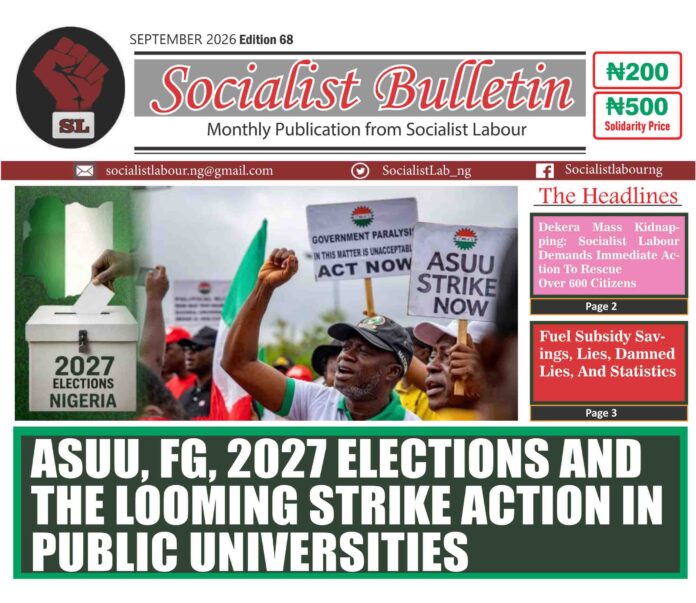

The Academic Staff Union of Universities (ASUU), led by Comrade Chris Piwuma, has renewed its resolve to fight for autonomy and welfare of lecturers in Nigerian public universities. At its National Executive Council (NEC) meeting held at the University of Abuja on 8–9 August 2026, ASUU condemned the delay in paying three and a half months of withheld 2022 salaries and the poor implementation of the December 2025 FGN-ASUU agreement. State universities remain worst hit, with less than 10% of them endorsing the agreement despite governors admitting to improved federal allocations and internally generated revenue. Consequently, ASUU authorized 20 state universities to embark on industrial actions. Already, Nasarawa State University, Keffi (NSUK), Kaduna State University (KASU), and universities in Bayelsa and Plateau have gone on strike, while 17 others prepare to follow. The 2025 FGN-ASUU agreement itself was born out of industrial action. At its NEC in Ibadan in August 2024, ASUU issued a 21-day strike notice over issues lingering since 2009.
If the current strike escalates, it will mark the 18th ASUU strike since 1999, the last being the 240-day action in 2022. Public university calendars have been repeatedly disrupted; only six of the past 25 years were strike-free. Students admitted for four-year programs often spend eight years before graduation. With 328 universities now in Nigeria—182 of them private—stable education has become a privilege of the wealthy, while children of low-income families remain trapped in unstable public institutions.
Today, students in state universities face uncertainty about their graduation timelines. President Tinubu had promised an end to industrial crises and full implementation of the 2025 agreement. Yet one year later, these promises remain unfulfilled. Many Nigerians believe the government is unwilling to fund public universities adequately. Left-wing intellectuals argue that the political class deliberately pauperizes lecturers, keeping them dependent and liable for electoral manipulation.
As the 2027 elections draws near, President Tinubu’s All Progressives Congress (APC) government need to be reminded that industrial actions by trade unions, particularly the strike action by ASUU, was part of the issues that facilitated its coming to power. The industrial issues were on the front burner of national discourse during the electioneering campaigns of the pre 2015 elections. For example, in 2014, ASUU and other university based unions were on strike for almost 9 months, while the federal government spent about N9 billion convening the National Conference. The labour issues accumulated, and were so intense that about 132, 228 workers went on strike in 2015 alone. Most of these workers were employees of public universities.
History underscores the political weight of ASUU strikes. Labour crises helped propel APC to power in 2015. Despite more Naira in revenue from devaluation, many state universities still refuse implementation of the 2025 agreement. Unless urgent action is taken, Nigeria risks yet another prolonged shutdown of its public universities, deepening the cycle of instability and eroding the nation’s educational foundation.
Download our full Socialist Bulletin for September 2026 with the link below: https://socialistlabour.com.ng/wp-content/uploads/2026/09/SL-bulletin-September-2026-1_compressed.pdf