


Tina Nkeche
For most people, physical security may be only a small part of the insecurity that they suffer every day – the main concerns for most people are how to get enough money for food, education, healthcare and the other essentials of life. Not only are these threats usually more common than the direct threats of physical security, but they also push some more people towards crime and other forms of illegality, including even suicide.
We desperately need to address all forms of security that the common people suffer with a new comprehensive approach to security that should be adopted by the Government – this was accepted by the NLC during their December 2025 protests. The trade unions need to be part of this process by making clear demands supported by robust strike action. This will begin to reverse the massive increase in poverty and inequality over the last decade and more that we have all suffered.
Addressing physical insecurity by increasing the number of police, soldiers and other security personnel is unlikely to lead to success in the short or medium term. The state has been fighting Boko Haram and other groups in the North East for 16 years. Action by the security forces did manage to dislodge Boko Haram from the many local government headquarters they occupied in 2014-15, but it has not eradicated them from the remoter rural areas that they now occupy.
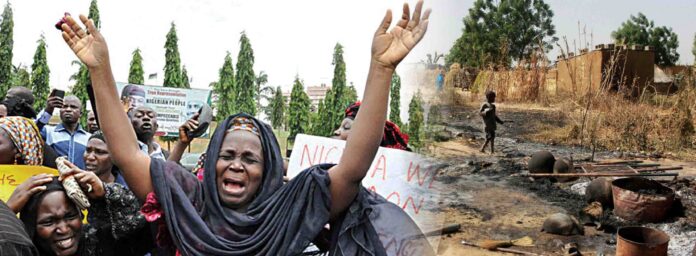
In addition, increasing action by the security forces may also lead to increases in innocent lives being lost. The security forces claim they are killing around 600 people every month and bombing raids are regularly undertaken in all six geopolitical zones, but insecurity continues to increase. The shoot to kill policy means many of those ‘neutralised’ may be innocent victims. Nine women were shot dead by the army on 9th December, 2025. They were protesting against the army’s handling of communal clashes in northeastern Adamawa.
It is not just the Nigerian security forces that are failing to quell insecurity. The military juntas in Burkina Faso, Mali and Niger are also failing to address insecurity. The number of attacks in the Sahel has exploded in the last six years, rising from 1,900 in 2019, mainly concentrated on the border between Mali and Burkina Faso, to more than 5,500 in 2024.
This is despite the support provided by French and now Russian security forces and the military coups whose main aim was claimed to be the need to address insecurity. In Mali the militants have stopped much of the fuel going to the capital, Bamako. Several European nations have recently advised their citizens to leave the country. There are many other examples of countries that have failed to address insecurity through miliary means. The US was chased out of Afghanistan and Britain had to reach a political agreement to end ‘the troubles’ in Northern Ireland, to name but two.
Last month the Minister of Health admitted that 850,000 children die every year from treatable diseases. This is perhaps 85 times the total number of people dying as a result of physical insecurity each year. In Katsina State half the children are estimated to be suffering from chronic malnutrition and 10% are suffering from life threatening acute hunger. But it is not just in the north, every state has horrendous levels of hunger. As a result, every day millions of people have to search and hustle to find enough money to find food for their children and other essentials for life. In these circumstances it is not surprising that a few of these people are tempted by crime or worse.
Daily insecurity of life for labouring people should be addressed by three basic trade union demands:
- immediate increase in the minimum wage and further annual increases to keep pace with inflation and the cost of living – these increased salaries would immediately be spent and so support those in the informal sector, especially market women (and so farmers) and okada drivers etc in every local government across the country.
- massively increasing funding for public education and ending all school fees for primary education with extensions to secondary education – this would immediately end the worry about paying for school fees each term and reduce leakages from the fees that are collected
- massively increasing funding for public health and ending all health fees (including tests and drugs) for primary health with later ending of fees for secondary and tertiary health – removing a great fear of how to pay for health treatment, the resulting debt that many families fall into and people not receiving treatments that are essential for their health.
These steps would immediately lift millions out of poverty and end the key reasons that families fall into debt. This would immediately remove direct threats to life for millions of people. It would also reduce the pressures for some of these people to turn to crime and other forms of insecurity. Giving people hope for the future would reduce their desperation and the temptation to commit illegal acts – that is why we need to demand mass action from the NLC and TUC to achieve the above demands.
Levels of all forms of insecurity have increased significantly in recent years with the increases in the levels of poverty suffered by most people. This should not be surprising, it has been repeatedly noted that increases in poverty lead to increased crime rates in many countries. Unemployment, especially of youth, is another major issue that has to be addressed.
All forms of insecurity have to be addressed comprehensively, especially by directly addressing poverty, inequality and unemployment. The wealth created by Nigerian workers has increased massively over the last 25 years and continues to increase. The latest figures for GDP growth show that the Nigerian economy is still growing faster than many countries. The problem is that with neoliberal reforms all this wealth is being taken by the corrupt elite. Globally, between 2000 and 2024, the richest 1% took 41% of the increased wealth, whilst the poorest 50% gained only 1% of this wealth (recent G20 report on inequality).
We need further robust action by the trade unions and especially the NLC and TUC to reverse the trend of growing inequality and poverty. This will begin to address the daily financial insecurity that most of us suffer. It will also begin to undercut the physical insecurity that too many of us are suffering.
Without access to food, education and medical care there is no security. The Government’s approach to security must take an urgent holistic approach for us to win the war against all forms of insecurity.