

Mass struggles across the federation in the late 1970’s forced the military regime of General Olusegun Obasanjo to lift the ban on politics and outline a time table for the return of civilian rule. A struggle of critical mass was the Ali Mon Go (Ali Must Go) protests. These shook the regime to its very foundations in 1978. Ali Must Go was the result of the regime’s attempt to impose austerity on the working people under the guise of what it called “low profile”.
In reality, low profile was austerity caused globally by a glut in the oil market (Imperialism attempting to break the back of OPEC) and internally by the profligacy and theft of state resources by the ruling classes in cahoots with its military wing. This had a deleterious effect on the financial health of the nation.The idea was to make working people pay for the crisis caused by the ruling classes. Colonel Ahmadu Alli, the Commissioner of Education, in line with with the drift towards austerity, announced an increase in university tuition fees. This caused a massive uprising of students and workers virtually bringing the nation to a standstill.
This uprising gave additional lustre to the free education programme of Chief Obafemi Awolowo’s Unity Party of Nigeria (UPN). The core plank of the UPN’s mildly Social Democratic redistributionist programme was that from the 1st October 1979, fees would be abolished for Primary and Secondary Schools across the nation if the party was able to capture power at the centre. Unfortunately, the party was only able to capture power in the South Western States: Lagos, Ogun, Oyo, Ondo, Kwara and the rump of the old Mid-Western Region which was renamed Bendel State. Incidentally, the military regime of General Obasanjo harbored suspicions that Awolowo’s party was behind the Ali Mon Go uprisings, using the protests as a means of railroading the government into endorsing the free education programme of the party.
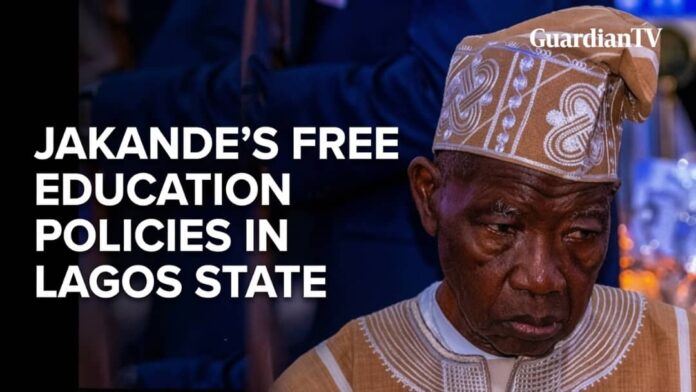
This article will attempt to examine critically the impact of the free education programme in Lagos State under the governorship of Alhaji Lateef Jakande, who was sworn in as governor on 1st October 1979. Prior to the ascension of Alhaji Jakande to the governorship of Lagos State, secondary school education was an elitist affair and a veritable privilege.
As of 1972, there were 100 secondary schools in Lagos State, a combination of Federal Government, State Government, Local Government secondary schools, alongside schools that were established and run by various religious missions, both Christian and Muslim. In addition to this was the entrance of private capitalists into the field who established Secondary Schools to make money, as the number of children seeking admission increased.
Statistics from 1972 indicate that there were 472 Primary Schools in Lagos State with an annual turnout of 96,000 school leavers per annum vying for admission to 100 Secondary Schools with accommodation for only 16,000 new intakes. Admission was strictly by a common entrance examination. Therefore, as many as 80,000 primary school leavers, almost 83% of primary school leavers, were left to roam the streets.
The new order commenced on 1st October 1979, the civilian administration of Alhaji Lateef Jakande was determined to implement the core party programme of free education in the state. Education at all levels was declared free in the state, the common entrance examination was abolished. This meant that all primary school students who were ripe for secondary school class one automatically qualified for admission. Private Secondary Schools in the state were abolished, books and stationery were supplied to all pupils free, boarding houses which were in many respects the conditioning ground for elite acculturation were abolished as the administration considered that with the establishment of new secondary schools, it provided sufficient educational institutions to cover all areas of the state. The administration sternly warned parents in the state that those who stubbornly insisted in continuing to send their children to private primary schools would not be entitled to admission to secondary schools in the state.
As can be imagined, these measures elicited a howl of protest from the middle classes to no avail. The measures adopted by the Jakande administration resulted in a massive increase in admission into secondary schools in the state. In the 1980/81 academic session 167,629 children were registered in secondary school against a total number of 66,473 children in the 1978/79 session.
There are many who believe that the success of the UPN’s programme was a result of the influx of oil money into the political economy of the nation. This only tells half the story. The party, especially in Lagos State, eliminated waste, fraud and theft of resources; freeing up resources for its core programme. Alhaji Jakande set the pace by using his own personal car as his official vehicle. Throughout his time as governor, he lived in his own residence, a humble home that he built in the Ilupeju area of Lagos.
The author of this article taught in a Lagos secondary school during this period. Despite having attended elite Lagos secondary schools in the early 1970’s, it gave him great joy to see the children of workers and the oppressed walking through the hallowed halls and corridors of the elite schools. The UPN free education policy opened the doors to children who in normal circumstances would have not seen the four walls of any school.
One of the biggest drawbacks of the policy was that there was no attempt to decolonize the curriculum and make it relevant to children who originated from non-elite class backgrounds. All the UPN did was to democratize the British public school elitist model that had been imposed on us by colonialism. Any attempt to decolonize education and refashion it into a tool for transforming consciousness of the youth along class lines, preparing them to be active tools in the transformation of their existential reality was frowned upon. Despite these drawbacks, the UPN programme of free education was a monumental attempt at mass education and manpower development, taking the burden of this off the shoulders of poor, impoverished working people.
For those who believe that socialism cannot work in Nigeria, even though the UPN were not remotely socialist, Jakande’s tenure in Lagos State demonstrated what a determined redistributionist government could do with little resources. Nigeria has fundamentally more resources now than it had between 1979 and 1983 so there is no reason why free and qualitative education cannot be provided to the youth of this nation from primary school to tertiary institutions. All we need now is class power and organization to fight to make our dreams a reality!
Tables
Table 1
Table Title
| Column Head | Column Head | Column Head | Column Head | Column Head |
| Row Head | 123 | 123 | 123 | 123 |
| Row Head | 456 | 456 | 456 | 456 |
| Row Head | 789 | 789 | 789 | 789 |
| Row Head | 123 | 123 | 123 | 123 |
| Row Head | 456 | 456 | 456 | 456 |
| Row Head | 789 | 789 | 789 | 789 |
Note: Place all tables for your paper in a tables section, following references and footnotes. Start a new page for each table, include a table number and table title for each, as shown. All explanatory text appears in a table note that follows the table, like this one. Use the Table/Figure style, available on the Home tab, in the Styles gallery, to get the spacing between table and note. Tables in APA format can use single or 1.5 line spacing. Include a heading for every row and column, even if the content seems obvious. A default table style has been set up for this template that fits APA guidelines. To insert a table, on the Insert tab, click Table.
Figures Title
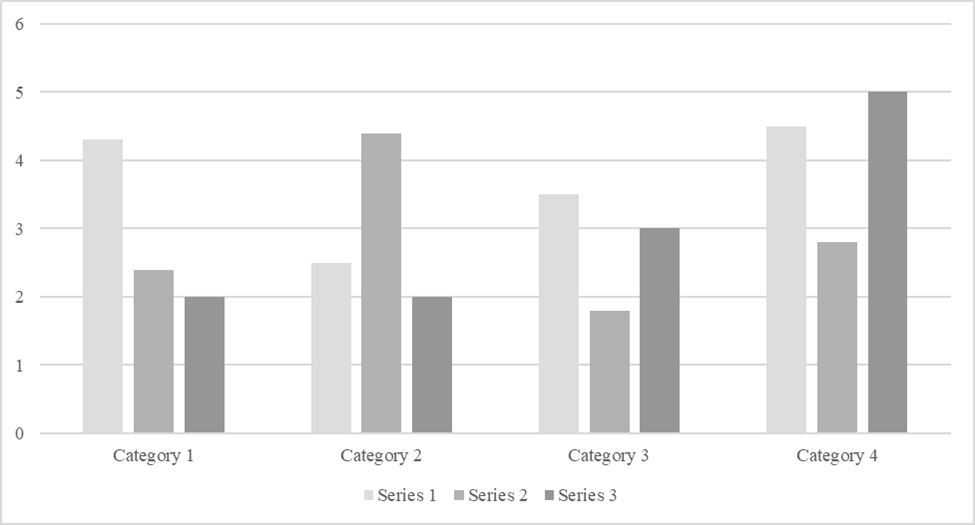
Figure 1.
Include all figures in their own section, following references, footnotes, and tables. Include a numbered caption for each figure. Use the Table/Figure style for easy spacing between figure and caption.
For additional information on APA Style formatting, please consult the APA Style Manual, 7th Edition.
References
Last Name, A. B. (Year). Article Title. Journal Title, Pages #-#. URL. URL.
Last Name, C. D. (Year). Book TitleBook Title URL.
Last Name, D. E., Last Name, F. G. (Year). Report TitleReport Title URL.
Last Name, H. I. (Year, Month Day). Article Title/Headline. Periodical.Periodical.
Organization Name. (Year, Month Day). Webpage Title. URL.