


Bashir Bello
From a Marxist perspective, the current wave of rural–urban migration in Nigeria is not a demographic accident nor a cultural phenomenon. It is a concrete expression of the disintegration of the peasantry under capitalist social relations. The growing influx of “’Yan ci-rani” (able-bodied men and women migrating seasonally to urban centres in search of menial labour), represents the gradual transformation of independent producers into landless or semi-proletarian labourers. Alongside them are refugees displaced by banditry, insecurity and climate disasters; forms of violence that are themselves rooted in material contradictions.
The visible army of beggars occupying the streets of Kano, Kaduna, and other major cities is not evidence of individual moral failure. Rather, it is the reserve army of labour produced by a system that has destroyed rural livelihoods without creating sufficient productive employment in the urban economy. As Marx observed, capitalism continuously produces surplus populations that exist on the margins of production, ready to be absorbed when profitable and discarded when not.
At the heart of peasant revolts, banditry, and rural insecurity lies the struggle over land, the primary means of production for the peasantry. In pre-capitalist and early post-colonial Nigeria, land functioned largely as a communal resource tied to subsistence production. However, with the expansion of capitalist relations, land has increasingly been subjected to commodification, state control, and elite appropriation. The number of landless peasants have increased fantastically within the last couple of generations.
Rapid population growth, (from less than 60 million at independence to over 240 million today) has intensified pressure on land. Yet population growth alone does not explain the crisis. The real issue is that capitalist development in agriculture has been uneven, extractive, and ecologically destructive, displacing peasants rather than improving their productive capacity.
Deforestation, desertification, climate change, and the breakdown of traditional bush-fallow systems are not merely environmental problems; they are consequences of capitalist penetration into agriculture, where short-term profit and increased output override long-term sustainability. The extensive use of chemical fertilizers to compensate for declining soil fertility reflects this contradiction: productivity is forced upward while the ecological base of production is steadily destroyed.
The massive construction of dams in the 1980s exemplifies what Marx termed primitive accumulation, the violent separation of producers from the means of production. Under the guise of “development,” large-scale state projects submerged fertile lands, displaced farming communities, and disrupted local agrarian systems. Promised irrigation schemes and economic benefits largely failed to materialize, while peasants were left landless and proletarianized without alternative means of survival.
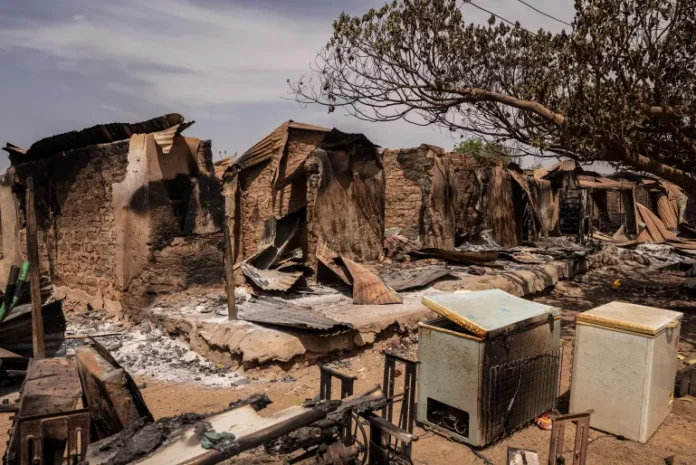
This process did not integrate the displaced population into productive capitalist employment. Instead, it created a mass of surplus rural labour, forced either into precarious urban informal work or into criminalized survival strategies. Banditry, cattle rustling, and armed rural conflicts thus emerge not as deviations from the system, but as social responses to dispossession.
What is commonly labelled as “banditry” should be understood as a distorted and reactionary form of class struggle. Deprived of land and excluded from stable wage labour, sections of the dispossessed peasantry resort to violence as a means of accessing resources. While lacking revolutionary consciousness and often reproducing brutal and predatory relations, these acts nonetheless reflect real material grievances rooted in land alienation and rural impoverishment.
The Nigerian state’s response to militarization and repression directly addresses the symptoms while preserving the underlying relations of exploitation. By treating insecurity as a purely military problem, the state obscures its own role in facilitating land dispossession, ecological destruction, and the pauperization of the peasantry.
In Marxist terms, Nigeria’s insecurity crisis is fundamentally an unresolved agrarian question. The peasantry has been destroyed as an independent class without being fully absorbed into a productive proletariat. The result is a swelling mass of semi-proletarians, informal workers, beggars, and armed outcasts, what Marx described as a population “redundant” to capital.
Looking at the land question through an elitist prism does grave injustice to the lived realities of rural communities. Across Nigeria, development has too often translated into displacement. Behind the language of modernization, urban expansion, free trade zones, and institutional growth lies a long history of peasant dispossession.
One of the most celebrated and tragic examples remains the Bakalori Dam project under the administration of Shehu Shagari. Conceived as part of the Green Revolution, the dam displaced thousands of farmers. Entire communities were uprooted from ancestral lands in the name of agricultural transformation. When displaced farmers protested poor compensation and loss of livelihood, they were met with military repression. Many lost their lives; others fled. What was branded as development became, for them, dispossession.
This pattern has repeated itself across the country. Governments and their capitalist agents have penetrated rural enclaves, acquiring vast tracts of land for industries, free trade zones, agencies, parastatals, military institutions, and urban layouts. In many cases, compensation was either inadequate or entirely absent. The result is predictable: peasants become landless, livelihoods collapse, and rural poverty deepens.
Kaduna is a clear illustration
In 2008, during the administration of Mohammed Namadi Sambo, the New Millennium City project was launched with grand promises of modernization. Over a thousand farming communities were displaced over time. Yet today, meaningful development on much of that land remains minimal, consisting largely of layouts and abandoned structures. Communities that had sustained themselves for generations through farming were dismantled. Many displaced residents migrated to urban centers in search of menial jobs, while others became intermediaries or land agents on lands they once owned.
Beyond Millennium City, Kaduna hosts major institutions occupying vast hectares of arable land, including the Nigerian Defence Academy, the Command and Staff College Jaji, and the recently established Green Economic Zone. Collectively, these and other institutions span enormous expanses of land, that once sustained peasant farmers. In many instances, acquisition occurred without adequate compensation or livelihood restoration. Farmers were transformed overnight into landless laborers.
The land question is not only social, but ecological.
Kaduna was not chosen by Frederick Lugard as the colonial administrative capital by accident. Its lush vegetation and the presence of River Kaduna made it strategically and environmentally attractive. The river once meandered expansively around the city, flanked by green belts and grazing routes.
Today, much of that vegetation has disappeared. River Kaduna has shrunk significantly due to urban encroachment, sand mining, deforestation, and climate pressures. Grazing routes along its banks have given way to residential developments. Forest reserves have been depleted by logging, bush burning, illegal mining, and land clearing.
Energy poverty compounds the crisis. With the high cost of electricity and cooking gas, a large proportion of residents rely on firewood and charcoal. This dependence accelerates deforestation. Despite laws banning logging, enforcement remains weak, and reforestation efforts are minimal.
Many lands still designated as “forest reserves” exist only on paper. They have been allocated to individuals who clear thousands of hectares under the pretext of agriculture, only to abandon them later. Without tree cover, the soil erodes, degradation intensifies, and desert encroachment advances.
There is a direct relationship between deforestation and desertification. Trees regulate water cycles, protect soil from erosion, and maintain ecological balance. When forests disappear, the land becomes vulnerable. What follows is not development but ecological decline.
Without a radical transformation of land relations through democratic control of land, ecological restoration, and planned agricultural development, rural insecurity will persist. The struggle over land is therefore not marginal; it is central to any revolutionary project aimed at resolving Nigeria’s social contradictions and dismantling the material foundations of violence, poverty, and displacement.