
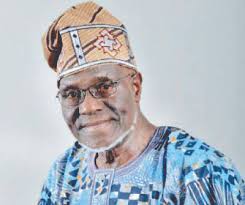

Comrade Salisu Nuhu Muhammad, the former Acting General Secretary of the Nigeria Labour Congress (NLC).
Until his voluntary retirement from active trade unionism a few years ago, the pioneer president of Nigeria Labour Congress (NLC), had been the longest serving Secretary General of the Accra-based, Organization of African Trade Unions Unity (OATUU), the workers’ apex continental body.
Comrade Hassan Adebayo Sunmonu is a truly iconic personality whose exceptional leadership qualities continue to inspire and radiate hope in the ranks of the hard toiling classes the world over. His ideas also fertilize and nourish the inexhaustible reservoir of wisdom that illuminates the difficult paths along which workers and the oppressed poor carry out their collective actions, selfless sacrifices, epic battles and heroic struggles.
On January 7th, 2021, the labour top brass from far and near, old associates, close friends and family members hurriedly organized a virtual reception to celebrate the eightieth birthday of the famous Nigerian twin brothers from Osogbo, Hassan and Wasilat.
Participants at the memorable Zoom labour gathering, as if in an open contest for a prize competition, could be seen frantically taxing their sharp brains to quickly remember and instantly share some interesting, cherished experiences and comradely encounters they had, at one time or the other, had with the duo of the celebrants.
The oft-repeated affirmations concerning the trustworthiness of comrade Hassan A. Sunmonu as a labour leader, was yet traced to another illustrious doyen of the labour movement, in the person of the late Comrade Wahab Goodluck, under whose able and enviable mentorship our celebrant cut his teeth.
As a student, Hassan A. Sunmonu was elected to a leadership position at Yaba College of Technology. He was then endorsed as a high ranking leader in the youthful cabinet of the national students’ body, the National Union of Nigerian Students (NUNS).
Sunmonu came to the national limelight in 1962 when he, along with a handful of other campus colleagues, mobilized the entire membership of the national students body to denounce and compel the immediate cancellation of the Anglo-Nigeria Defense Pact, by the then just elected conservative government of Prime Minister Abubakar Tafawa Balewa.
In the Federal Ministry of Works, where he secured employment as an Engineering Field Works Senior Supervisor, he confided in his twin brother his firm resolve to make the defense and promotion of the interests and rights of the rank and file workers in the ministry, his top organizational priority.
This resolution brought him into open confrontation with some powerful groups occupying managerial cadre inside the ministry. They were busy perverting the cause of justice by immersing themselves in dirty financial deals and some unpleasant and clearly anti-labour practices.
Under Sunmonu’s dynamic and able branch leadership, the Federal Ministry of Works, to the manifest annoyance of all its highest management officials, became a beehive of radical labour activism.
The unquestioned superiority of Comrade Sunmonu’s preferred socialist model of trade union organizing was eloquently demonstrated when a multitude of workers started trooping to join the in-house unions. This was in total defiance of a standing directive from the ministry’s top hierarchy, prohibiting all workers from taking such a radical step.
The contagion effects of this good leadership soon spread to other ministries, where workers enthusiastically moved in droves to join and fortify the fledgling trade unions structures. Comrade Wahab Goodluck then head hunted him for a more challenging labour task.
The Murtala/Obasanjo military regime came to power by ousting the government of General Yakubu Gowon in 1975. Barely two years later it was caught in a powerful raging labour storm.
There was an unhealthy rivalry between the leaders of the then four (4) registered central labour organizations, i.e, the Nigeria Trade Unions Congress (NTUC), United Labour Congress (ULC), Labour United Front (LUF), and Nigerian Workers Council (WC). This was confounding the ongoing crisis of national instability for which the ruling military junta seemed to lack any workable solution.