

By Ousmane Ndiaye
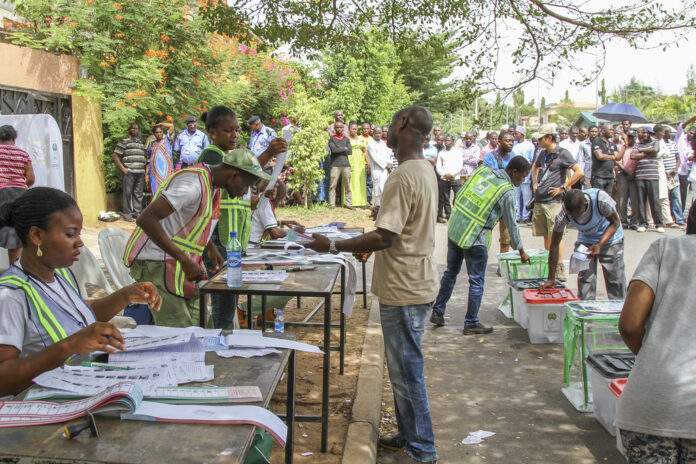
In too many African countries, voting is not intended to give citizens a genuine voice but rather to satisfy formal requirements valued by the international community. This reality has created fertile ground for a wave of civilian coups—conditions that, in turn, invite military takeovers. Ivory Coast, Cameroon, and Tanzania in October, and the Central African Republic and Guinea in December, all held elections that were, to varying degrees, non-inclusive, unfair, rigged, or manipulated. Most recently, in Uganda, Yoweri Museveni in power for nearly four decades declared himself the winner of yet another sham election, his eighth, while unleashing violent repression against the main opposition leader, Bobi Wine, now in hiding, and his supporters. Dozens were killed, thousands arrested, the internet was shut down, security threats invoked, and foreign conspiracies alleged. The script of power seizure through elections has become almost immutable.
This ongoing electoral cycle confirms the persistence of civilian coups in Africa. This time, however, the instruments are not weapons, as in military coups, but elections—or rather, the illusion of elections. Paradoxically, popular voting has become one of the most common and convenient tools for seizing power on the continent. As in Uganda, presidential elections function merely as moments of institutional re-legitimization, not as genuine reassessments of political authority. This is one of the central maladies of Africa’s fragile democracies: electoralism, where democracy is reduced to the mechanics of access to power and its distribution. In these procedural “democracies,” voting retains value only insofar as it confers international recognition. Paul Biya in Cameroon, Samia Suluhu Hassan in Tanzania, and their counterparts will ultimately be recognized by the African Union, the United Nations, and the European Union despite temporary diplomatic reservations, if any. France, for instance, was quick to congratulate Alassane Ouattara in Ivory Coast, Faustin-Archange Touadéra, and Mamadi Doumbouya in almost identical terms.
Such recognition is hardly surprising. International institutions promote a normative and institutional vision of democracy: tick the boxes, follow the procedures, and legitimacy follows. In these African democratic fictions, voting is not meant to provide citizens with a space for expression but to comply with external norms, constituting a profound subversion of the very spirit of suffrage.
To understand this recurring trap of elections without democracy, one must return to the 1990s.
Single-party regimes were shaken by the global wave of democratic demands following the fall of the Berlin Wall, amplified in Africa by decades of social and political struggle for pluralism. In response, regimes convened sovereign national conferences. These assemblies won through immense sacrifice represented extraordinary moments of liberated speech and democratic aspiration. Yet the awakening proved short-lived. Very quickly, national conferences became instruments for adapting authoritarian regimes to the new international order. Thus emerged what can be described as Africa’s “democratic fictions” a legacy that persists to this day. The most emblematic figure, and the unwitting theorist of this hijacking of popular sovereignty, was Gabonese President Omar Bongo. His oft-quoted maxim still resonates across the continent’s presidential palaces: “In Africa, elections are not organized to be lost.” Sadly, the current electoral cycle proves him right more than ever.
The engineering of these democratic fictions—carefully aligned with international standards—has become increasingly sophisticated. Constitutions are drafted by renowned legal scholars, often imported from former colonial powers. On paper, they impose term limits, empower legislatures to oversee executives, guarantee judicial independence, and define the rights and funding of opposition parties. In practice, term limits are violated, legislatures are subordinated, the judiciary lacks independence, and opposition parties are neither recognized nor funded. Electoral codes rival those of advanced democracies, providing for citizen oversight and opening all stages of the process to opposition parties and national and international observers. Election observation has become so routine that it now constitutes a lucrative industry. In reality, citizen oversight is obstructed, opposition participation restricted, and international observers often confined to luxury hotels in capital cities, escorted only to carefully selected polling stations.
A central institutional legacy of the national conferences was the creation of Independent National Electoral Commissions (CENIs), celebrated as a democratic breakthrough but, in fact, a false trophy. Conceived as a transitional solution, they became permanent fixtures. The logic seemed sound: since state administrations—aligned with ruling parties—could not be trusted to organize elections, the task was delegated to supposedly representative commissions. Elegant in theory, disastrous in practice. CENIs have become symbols of democratic regression. While they bear formal responsibility for elections, operational resources remain firmly controlled by state administrations, especially at the local level. What was meant to be temporary has become entrenched. Under-resourced, poorly constituted, occasionally corrupt, and endowed with vague mandates, CENIs have become nightmares of post-conference democratic processes and central instruments of electoral manipulation, often triggering threats or boycotts due to suspicions of bias.
Another defining feature of these democratic fictions is the instrumentalization of the judiciary to eliminate serious political challengers. Tidjane Thiam in Ivory Coast, Maurice Kamto in Cameroon, Kizza Besigye in Uganda, and countless others have paid the price. The judicialization of political competition has become systematic. Here, the law—meant to safeguard democracy—is deployed against it. Legal formalism becomes the shield behind which profoundly undemocratic practices are defended, rendering genuine political change virtually impossible. Some regimes have gone even further by staging fictitious transfers of power. Consider Togo. After two decades in power, Faure Gnassingbé orchestrated a cosmetic transition. On May 6, 2025, Jean-Lucien Savi de Tové, a largely unknown figure, was sworn in as President of the Republic. The role, however, had been stripped of real authority. Three days earlier, the National Assembly had appointed Faure Gnassingbé as President of the Council of Ministers, effectively allowing him to retain power under a new title. This maneuver followed a controversial constitutional change in April 2024, when a simple parliamentary vote shifted Togo from a presidential to a parliamentary system, despite widespread opposition protests. The objective was clear: to circumvent presidential term limits. Had Gnassingbé remained president, he would have faced universal suffrage and, at most, a final term.
In these democratic fictions, the manipulation of texts and institutions to lock in power knows no bounds. Increasingly, however, security crises are exposing the fragility of these narratives. In the Democratic Republic of Congo, the protracted war in the East—once promised to be resolved in one hundred days by President Félix Tshisekedi has revealed the shallow legitimacy of the state. One should also recall that, prior to 2010, Mali was celebrated as a “model democracy.” Countless reports praised General Amadou Toumani Touré’s “democratic dialogue,” yet the rapid collapse of the Malian state in 2012 laid bare the fragility of this carefully constructed narrative. This fiction was upheld by elites of the 1990s democratic movements, validated by international organizations, and reinforced by pro-democracy NGOs and media-friendly rankings distinguishing “good” from “bad” students.
Today, the trap is closing. A new generation, exhausted by hollow electoral rituals that fail to reflect popular will, is developing a political consciousness hostile to democracy itself, often equating it, through crude simplifications, with Western imperialism. These civilian coups against democracy have paved the way for military coups. In Mali, Niger, and Burkina Faso, this dynamic—combined with security concerns—is invoked to justify the unjustifiable: self-appointed, renewable mandates without elections, the suspension of universal suffrage, and the dissolution of political parties.
Nigeria cannot afford to ignore these patterns. With a history of military interventions and a democratic framework still grappling with institutional weaknesses, the country sits at a delicate juncture.
Electoral manipulation, judicialisation of politics, and elite capture already visible in various states could gradually erode public trust in democracy. If left unchecked, Nigeria risks following the path of its neighbors: civilian-led “democratic fictions” paving the way for either authoritarian consolidation or military intervention. Without genuine political reforms, respect for institutional checks and balances, and protection of the popular will, Nigeria may confront the same cycle of elections without democracy, civilian coups, and instability that now engulfs much of West and Central Africa.